
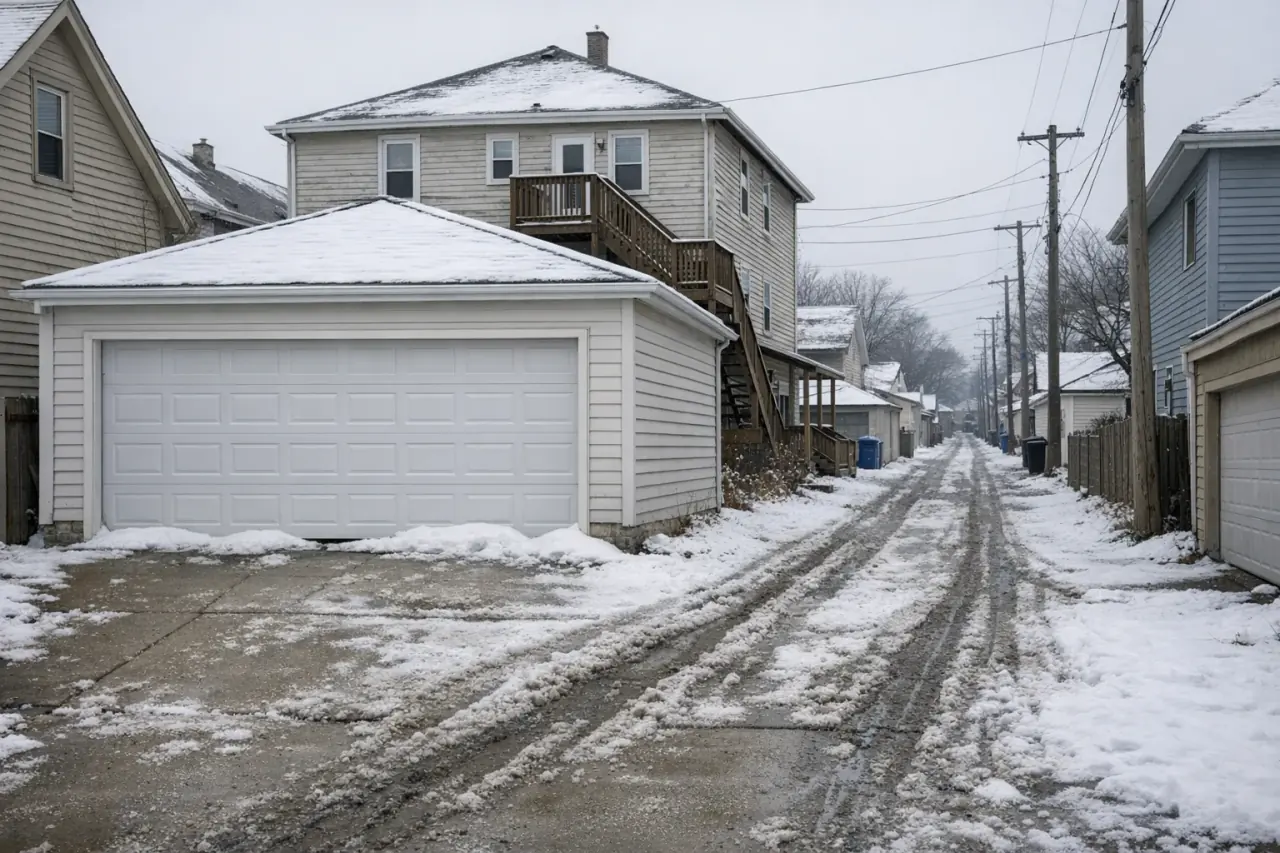
Plenty of garage doors in this city serve two families. The up-and-down duplex, one flat stacked over another, was already described as the most common house type here in a 1911 British Board of Trade study. Polish flats, cottages that owners jacked up so a second unit could be built underneath, add many more two-household homes.
Behind many of these houses stands one detached garage near the alley, shared by upstairs and downstairs. That means double the trips, double the slush hauled in, and two sets of remotes that both have to work on a February morning. Add wind off Lake Michigan and a ban on overnight street parking, and a jammed door strands two households at once.
Upper flat, lower flat, one set of springs
Springs are sold by cycle rating, one cycle being a single open and close. Standard springs are commonly rated for roughly 10,000 cycles, which one family can stretch over many years. With each flat making two or three trips a day through the same door, that budget runs out far sooner, usually ending in a loud crack and a door the motor can no longer raise.
Ask about high-cycle springs, built with heavier wire or longer coils, and whether both springs should be replaced together, since the survivor has done identical work. An opener with a soft-start DC motor is also gentler on a hard-worked door than an older unit that jerks it into motion at full speed. Nobody in either flat should loosen, wind or swap a spring or lift cable; both store enough energy to break bones when they let go.
Remotes, keypad codes and move-out day
Give each flat its own remote and, where the keypad allows several, its own code. Most openers built in recent decades use rolling codes and a learn button on the motor head; on many models, holding it until the light goes out erases every paired remote.
That reset is a safe homeowner task worth doing whenever a tenant moves: wipe the memory, then re-pair the remotes that stay. Many Wi-Fi openers let an owner invite each household as a separate user and remove a departing one without touching anyone else's access.
Find out which electrical panel feeds the garage. The circuit may run from the lower unit, the upper unit or a house meter, so the upstairs household might have no way to reach a tripped breaker when the opener goes dark. Label it inside the garage.
A jammed door and the 2 a.m. parking ban
Milwaukee bars parking on city streets from 2 to 6 a.m., Monday through Saturday, unless a car has an overnight permit or temporary night parking permission. If a stuck door leaves a car outside, request that temporary permission through the city's online form early in the evening, then book the repair; the city caps how often one car can use it. Winter rules run December 1 to March 1, and a declared snow emergency adds citywide alternate-side parking from 10 p.m. to 6 a.m.
Leave the red emergency release alone while the door is stuck open; with a failed spring, a disconnected door can crash to the slab, and nobody should try to catch it. Lock the side entrance and ask for an emergency visit, available 24/7.
Lake breeze near Bay View, easterly snow citywide
From March through July, a breeze off the lake often pushes cool, damp air inland on days that began warm. Garages near the shore, around Bay View in 53207, can turn cool and damp within an afternoon, and that repeated dampness wears on bare hinges, rollers and spring coils. Neighborhoods farther from the water usually feel it less.
In winter the lake softens the harshest cold along the shoreline, but easterly winds, less common than the prevailing westerlies, can drop lake-effect snow and pile it against anything facing them. A door on that side collects snow under its bottom seal and along the jambs, where it melts by day and refreezes overnight.
Before the first storm, check the vinyl stop molding for gaps that show daylight and replace a stiff bottom seal. If ice glues the door down, chip it free with a plastic scraper and sweep away the meltwater before it refreezes; an opener straining against a frozen door can strip its drive gear.
Brine from two cars, and picking a replacement
Every car rolling in on a slushy night leaves salty water where the door meets the floor, and a shared garage gets it twice. Corrosion usually shows up first on the lowest edge of a steel door, the bottom hinges, the foot of each track and the brackets anchoring the lift cables. Those brackets hold cable tension, so point out scaly or swollen ones to a technician rather than prying at them.
Hose off the threshold during each thaw, and agree between flats on whose job that is. For a replacement, galvanized steel with a baked factory finish, or a fiberglass or composite skin, shrugs off brine longer; near the lake, add galvanized or stainless hinges and fasteners.
Southeastern Wisconsin places reached so far, by county
Requests from these communities have already been routed to a technician; if yours isn't listed, just ask.
- Milwaukee County: Milwaukee (53207, 53208, 53209, 53210)
- Waukesha County: Waukesha (53189), which has its own page, and New Berlin (53151)
- Washington County: Germantown (53022), Jackson (53037) and West Bend (53095)
- Ozaukee County: Saukville (53080)
- Racine County: Burlington (53105)
- Kenosha County: Kenosha (53144) and Salem (53168)
Last updated by the American Garage Door Team.