
Does the brand on a garage door really matter?
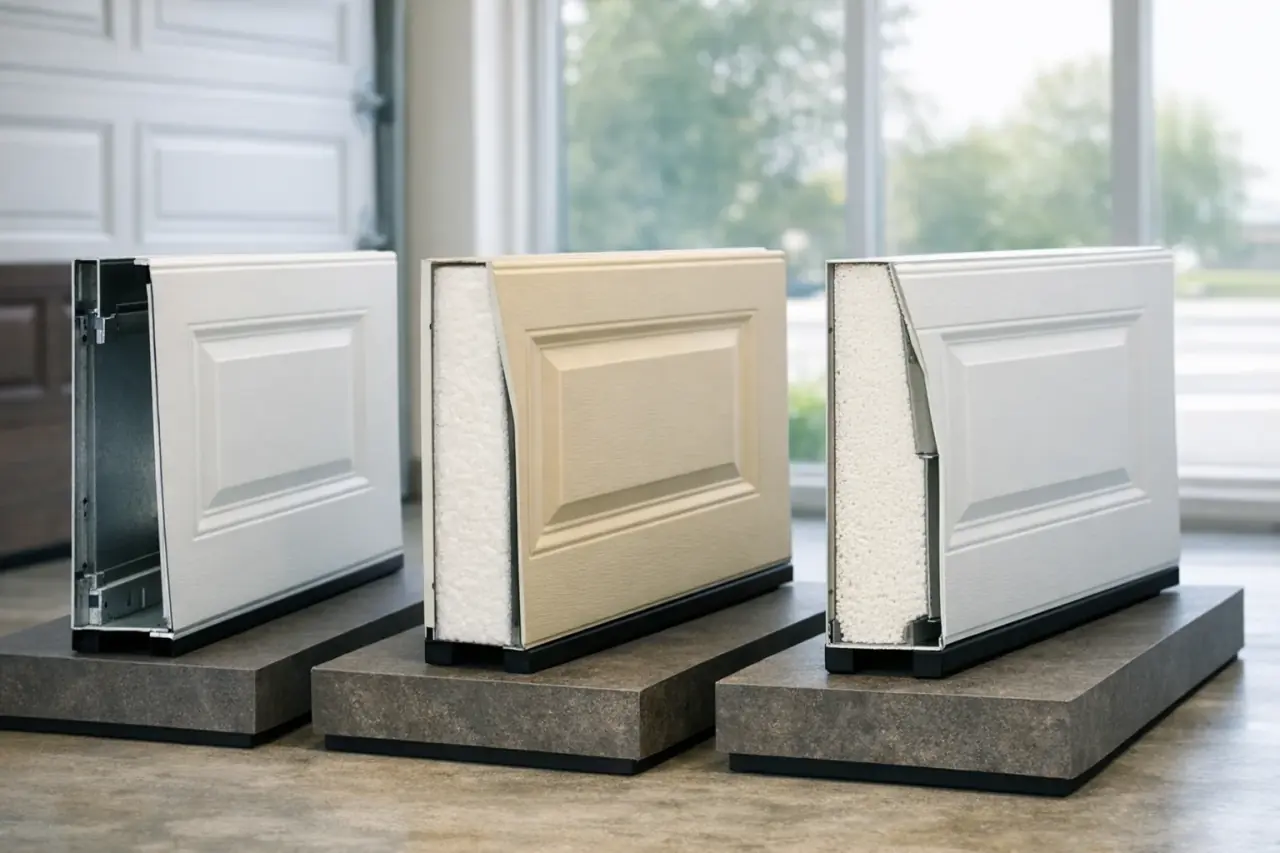
Less than the advertising suggests. The large residential manufacturers all build the same basic families of steel door: a bare single skin, a skin with foam behind it, and a sandwich of steel, foam and steel. What separates them is how they label those tiers, what their warranties promise, how you buy the door and a handful of proprietary parts.
This guide sticks to what each manufacturer states on its own website, checked in October 2026. Specs and terms change, so treat it as a map for comparing quotes, not a ranking.
Five things are worth comparing between any two brands:
- Construction tier: the number of layers and the thickness of each section
- Insulation: rigid polystyrene boards or injected polyurethane, and how the rating is measured
- Warranty: what each component is covered against, and for how long
- Sales channel: dealer-only, retail or both, which shapes service and parts later
- Counterbalance: standard torsion hardware or a proprietary spring design
Who makes the major garage door brands?
Several familiar names share a parent company. Here's how each maker describes itself.
| Brand | Background, per the company's website |
|---|---|
| Clopay | Calls itself North America's largest garage door manufacturer; headquartered in Mason, Ohio; part of Griffon Corporation |
| Amarr | Started by Abe, Morris and Herb Brenner in 1951; part of ASSA ABLOY; says all its products are made in the USA |
| Overhead Door | Founder C.G. Johnson created the original upward-acting garage door in 1921; parent Overhead Door Corporation is based in Lewisville, Texas, and belongs to Sanwa Holdings |
| Wayne Dalton | A sister brand of Overhead Door within Overhead Door Corporation, which also owns TODCO and the Genie opener company |
| C.H.I. Overhead Doors | Began making doors in 1981; the initials stand for Coach House, Inc.; says its doors are made primarily from Nucor steel |
| Raynor | Describes itself as a family business; based in Dixon, Illinois, with roots in 1944 |
| Haas Door | Based in Wauseon, in northwest Ohio, with a dealer network |
Shopping for an opener too? Our opener brand comparison sorts out who makes Genie, LiftMaster and Chamberlain.
How do construction tiers line up from brand to brand?
Nearly every maker sells three or four steel tiers under different names. Clopay's Gallery Steel line comes in 1-, 2- or 3-layer builds. Amarr's construction guide runs from single-layer up to four-layer, where the fourth layer is composite overlay trim. C.H.I. describes the same idea as "1-sided" and "2-sided" steel, in sections 1-1/2 or 2 inches thick, and Raynor's polyurethane doors come in stacks of three to five layers.
| Wording on a quote | What it usually describes |
|---|---|
| Single-layer, pan door, 1-sided uninsulated | One steel skin with an open back |
| Two-layer, 1-sided with vinyl back | A steel face with foam behind it and a vinyl backer |
| Three-layer, 2-sided, sandwich | Steel, then insulation, then steel facing the garage |
| Four- or five-layer | A sandwich door with composite cladding or overlay trim on the outside |
Line up tiers before you line up prices. Putting a two-layer door from one company against a three-layer door from another tells you nothing about either brand. Our garage door materials guide covers steel, wood, composite and the other options in depth.
Why can't you compare steel gauge at face value?
Each brand pairs gauge with construction in its own way. On C.H.I.'s raised-panel line, the heavy-duty single-skin models use 24-gauge steel, while its heavy-duty 2-inch, two-sided polyurethane models are listed at 27 gauge. Haas lists 26-gauge galvanized steel for its 2000 Series, reinforced by 20-gauge back-up plates that run the full height of every section.
Some makers skip the number entirely. Amarr's Lincoln and Olympus pages describe "heavy-gauge, nominal steel," and Clopay mentions gauge on its Gallery Steel page mainly to note that premium colors come only on 24-gauge steel. If thickness matters to you, ask the dealer for the spec sheet of the exact model rather than the collection.
Lower gauge numbers do mean thicker steel. Still, two thin skins bonded to a foam core can resist dents and flexing better than one heavier skin with nothing behind it, so compare gauge only between doors built the same way.
How do insulation ratings compare across brands?
Two foams dominate. Polystyrene arrives as rigid boards fitted into each section, while polyurethane is usually injected as a liquid that expands to fill the cavity. Clopay brands its injected foam Intellicore and Raynor calls its version NeuFoam; Amarr, C.H.I. and Haas simply say polyurethane.
Published figures as of October 2026:
- Clopay: R-6.5 to R-18.4 across Gallery Steel options, with its Intellicore table reaching R-20.4 on certain Canyon Ridge models
- Amarr: R-6.48 to R-9.05 for polystyrene Lincoln doors, and R-13.35 or R-19.40 for polyurethane Olympus doors, depending on whether the foam is 1-3/8 or 2 inches thick
- C.H.I.: R-17.19 listed for polyurethane on its raised-panel line
- Haas: a tested U-factor of 0.094 for the 2-inch 2000 Series, where a lower number means less heat loss
- Raynor: calls polyurethane its highest-R option without giving a figure on that page
Clopay's own insulation guide draws a helpful line: R-value describes individual materials or sections, while U-factor accounts for the whole door, joints and thermal breaks included. Where a brand publishes a whole-door number, that is the fairer comparison. Match thickness as well, pitting 2-inch doors against 2-inch doors. If you're still deciding whether foam is worth paying for, read insulated vs. non-insulated doors.
What do the manufacturer warranties actually promise?
Every brand advertises long coverage, and the differences hide in the component terms. Here's how several publish theirs:
| Brand | What its website states |
|---|---|
| Raynor | Sections covered against rust and delamination for as long as you own your home; powder-coated EnduraCote track, hardware and springs for the same period; galvanized track and hardware six years, galvanized springs three years |
| Haas (2000 Series) | Rust-through and delamination coverage for life; finish 10 years (12 on plank options); hardware 6 years; springs 3 years |
| C.H.I. | Limited lifetime coverage that varies by model; the raised-panel line lists 6 years on hardware and 3 on springs, and an optional Lifetime Package extends lifetime coverage to both; defects are reported to the selling dealer |
| Amarr | Product pages carry a lifetime icon; the full terms sit in each door's warranty document |
| Clopay | Participating dealers give at least a one-year installation warranty on replacement doors; door coverage is set out in each product's warranty document |
Look at how far apart the spring terms are. Three years and "as long as you own your home" are very different promises, so ask which spring option your quote includes and read the actual document.
Exclusions deserve the same attention. C.H.I.'s two-sided steel warranty, for instance, rules out damage from salt environments including coastal areas, and asks owners to contact the selling dealer within 15 days of discovering a defect. Our explainer on how garage door warranties work covers common exclusions such as salt air and DIY repairs.
Does the sales channel affect service and parts later?
It does, mostly years after the sale. C.H.I. says every door, replacement part and accessory it makes is sold through its dealers, and Raynor doors are sold, serviced and installed through authorized dealers. Clopay reaches buyers through more than 3,000 independent dealers and retailers, including The Home Depot. Amarr pairs more than 4,000 independent dealers with over 60 of its own Door Centers across the US, Canada and Mexico.
Here's why that matters to you:
- Warranty claims usually begin with whoever sold the door, and C.H.I. states this outright.
- Matching sections are simplest to source through a dealer who stocks that brand. If one panel gets dented down the road, the brand, model and color on the door's label decide whether a match exists.
- Install quality varies by dealer. Clopay's insulation guide notes that professional installation typically preserves the manufacturer's warranty.
Before you sign, ask whether the dealer keeps replacement sections and hardware for the door being quoted. If a single section is damaged later, section replacement starts with that label information, and our guide on whether to repair or replace helps with the bigger call.
What about proprietary spring systems like TorqueMaster?
Most residential doors use standard torsion or extension springs, which any trained technician can size and replace. A few use proprietary designs, and the most familiar is Wayne Dalton's TorqueMaster, which hides the springs inside a steel tube above the door.
TorqueMaster isn't a defect, but it changes the service picture. Its springs and parts don't swap with standard torsion hardware, and the original and Plus versions use different components. When one fails, the options are a like-for-like repair or a conversion to standard torsion, both explained in our TorqueMaster spring guide. Before buying any door, ask who nearby stocks its spring parts.
Safety note: Enclosed or exposed, every counterbalance spring is wound tight enough to carry the full weight of the door. Never try to wind, adjust or release torsion springs, or disconnect lift cables, on your own. That stored energy can cause serious injury, so spring and cable work belongs with a trained technician.
How do the common head-to-head matchups compare?
None of these pairings has a universal winner. These notes show where each pair genuinely differs, based on the companies' own sites.
Clopay vs. Amarr
Both sell full steel lineups with polystyrene or polyurethane foam. The sharpest contrast is the channel: Clopay is available through dealers and The Home Depot, while Amarr leans on independent dealers and its Door Centers. At 2 inches, Amarr's polyurethane Olympus and many of Clopay's Intellicore doors are rated somewhere between about R-18 and R-20, so compare specific models at equal thickness.
Clopay vs. Wayne Dalton
Wayne Dalton belongs to Overhead Door Corporation, and Clopay to Griffon. The practical question with a Wayne Dalton quote is which counterbalance that model uses, TorqueMaster or standard torsion, because it shapes every future spring repair. With either brand, ask for the spec sheet covering layers, gauge and foam.
Clopay vs. C.H.I.
C.H.I. is dealer-only and publishes unusually detailed model tables, including gauge by model and an R-17.19 polyurethane option on its raised-panel line. Clopay is sold more widely, including at a home center. One detail for South Florida: C.H.I.'s raised-panel page states it doesn't currently hold Miami-Dade certifications, which matters in Miami-Dade and Broward counties, where garage doors must be approved for the High-Velocity Hurricane Zone. Clopay offers WindCode reinforcement for high-wind areas; with any brand, confirm the approval covers your exact door and size.
Amarr vs. Wayne Dalton
Amarr says its WindPro reinforcement can be added to nearly all of its doors, and that a local dealer confirms the rating your area requires. With Wayne Dalton, the TorqueMaster question comes first. For both, request the written warranty for the model on the quote rather than relying on a brochure.
Where do Overhead Door, Raynor and Haas fit?
Overhead Door shares a parent with Wayne Dalton. Raynor ties spring and hardware coverage on powder-coated parts to home ownership, and Haas lists gauge, foam and warranty by series, so either deserves a fair look if a dealer near you carries it.
Why does the installation matter more than the logo?
A premium door hung badly will run worse than a basic door hung well. The installer's work decides how the door behaves every day:
- Spring sizing: springs must suit the actual weight of the door you bought, windows and overlays included
- Track alignment: a door set out of square chews through rollers and binds in the track
- Sealing: the bottom seal and perimeter stops decide how much of that published R-value you feel
- Wind reinforcement: Amarr notes the homeowner is responsible for meeting local codes, so the installer should confirm your requirement; see our wind-rated door overview
- Opener setup: force, travel limits and auto-reverse need resetting for the new door
What should you ask before settling on a brand?
- Which exact model are you quoting, and how many layers does it have?
- What gauge are the skins, and is there steel on the inside face?
- Which foam fills the sections, how thick is it, and is the rating per section or whole door?
- Does the door use standard torsion springs or a proprietary system, and are higher-cycle springs offered?
- What does the written warranty say about sections, finish, hardware and springs?
- Who files warranty claims, and do you stock replacement sections for this line?
- Does this model meet the wind-load rules where I live?
- How long is your own workmanship warranty on the installation?
For vetting the company behind the quote, use our checklist on choosing a garage door company. For budgeting, our new door cost guide lays out typical ranges.
When should you call a pro?
Bring in a technician when:
- You're replacing a door and want the opening measured, with headroom and framing checked
- Your current door has a broken spring or cable, especially a TorqueMaster door
- A section is damaged and you need to know whether the maker still offers a match
- You live in a wind-rated area and need the right approval for your opening
We can send a technician for a free estimate on a new door installation, and spring trouble goes to spring repair. Not sure where to begin? Contact us and describe your door.
Key takeaways
- The major brands sell similar one-, two- and three-layer steel doors, so match tiers before comparing.
- Steel gauge only compares fairly between doors with the same construction.
- Compare insulation at equal thickness, and favor whole-door ratings where published.
- Spring and hardware warranties range from three years to as long as you own the home.
- Ask whether the door uses standard torsion springs or a proprietary system like TorqueMaster.
- Dealer support and installation quality matter at least as much as the name on the door.