
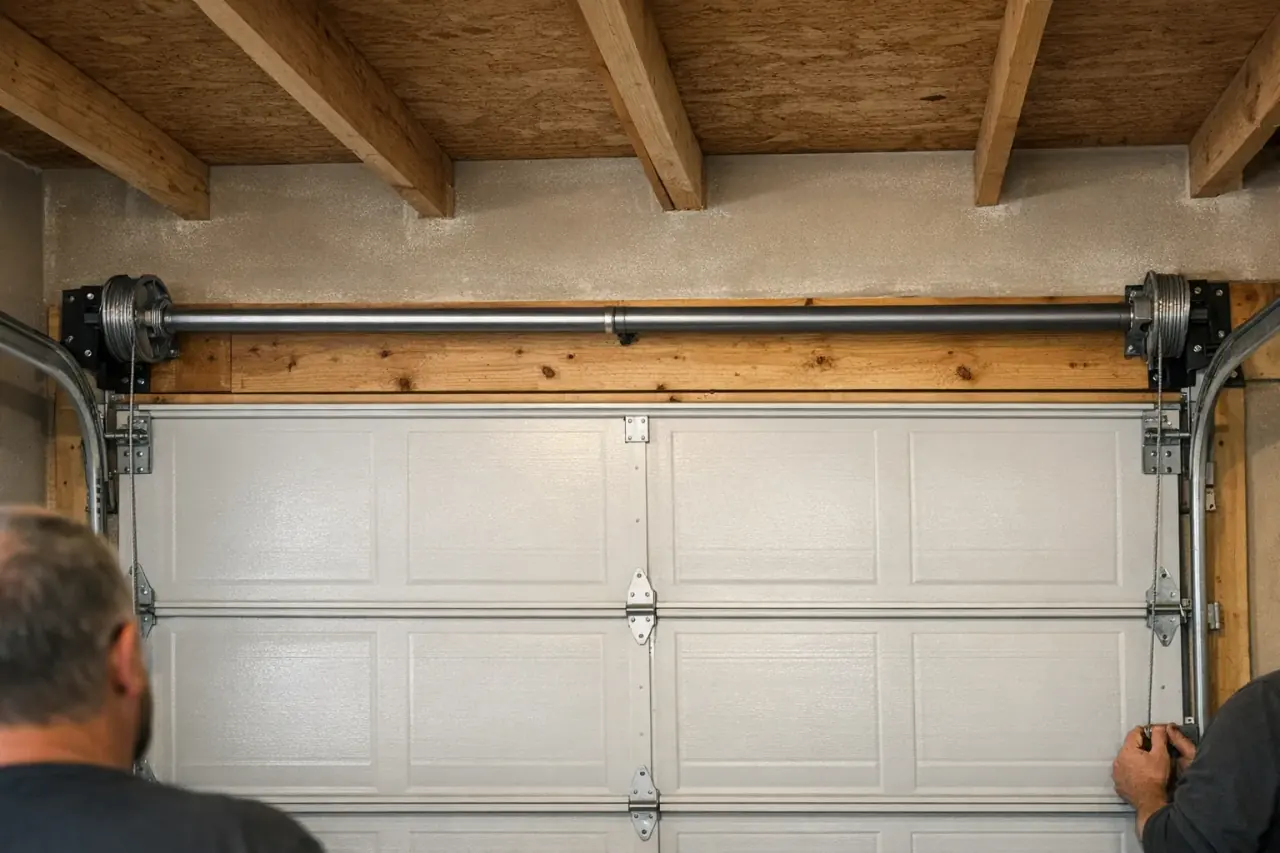
What is a Wayne Dalton TorqueMaster spring?
TorqueMaster is Wayne Dalton's enclosed counterbalance system. Like a standard torsion system, it uses wound springs to offset the weight of the door so a person or an opener can lift it. The difference is where the springs live: instead of riding on the outside of a steel shaft, they're sealed inside a steel tube that spans the top of the opening.
You'll find it mostly on Wayne Dalton residential steel doors. The tube has a cable drum at each end, and the winding mechanism sits at the end brackets. Earlier versions use a different winding design than the later TorqueMaster Plus, which uses a ratcheting winder. That matters for parts, because the springs and components for each version aren't interchangeable with standard torsion parts.
How can you tell if your door has one?
With the door down, look up at the header wall from inside.
- A smooth tube across the header, with no visible coils, points to TorqueMaster.
- Exposed coil springs on a shaft above the door mean a standard torsion system.
- Long springs running along the ceiling tracks on each side mean extension springs.
- A Wayne Dalton label on the door or end brackets helps confirm it.
Not sure which springs you have? Our guide to torsion vs. extension springs describes how to recognize each type.
How do you know a TorqueMaster spring has broken?
With an exposed torsion spring, a technician can often see the break: a gap a few inches wide in the coils. TorqueMaster hides that, so you have to read the door instead.
- A sharp bang, sometimes heard while the door is sitting idle
- A suddenly heavy door, much harder to raise by hand than it used to be
- The opener lifts it a few inches and stops, or strains and reverses
- The door rises unevenly or sits crooked in the opening
- Cables hang slack or have come off a drum, which can happen on single-spring doors when the spring breaks
- The door comes down hard instead of easing to the floor
To check safely, close the door completely, pull the opener's release cord, and try to lift the door a foot or so. If it barely moves or feels far heavier than usual, stop there. Let it back down gently and leave it closed.
Safety warning: Don't keep running the opener on a door with a broken TorqueMaster spring. The opener isn't built to lift the full weight of the door, and a door without spring support can drop quickly. Keep the door closed, keep people and pets clear, and call for service.
Why isn't TorqueMaster spring repair a DIY job?
Because the springs are out of sight, the system can feel less dangerous than an exposed torsion spring. It isn't. The spring inside the tube is still wound to hold the door's weight, and that stored energy is released through the winding hardware and drums at the ends.
A correct repair also depends on details that are easy to get wrong:
- Matching the spring to the door's weight and height, and to its wind direction
- Identifying the right version, since original TorqueMaster and TorqueMaster Plus parts differ
- Checking the drums and cables, which often wear along with the springs
- Rebalancing the door after the new springs are in, so it stays put halfway up
Online kits and videos make the job look routine. A mismatched spring leaves the door too heavy or too light, which strains the opener, and a slip while winding can cause serious injury. This is the same reason we steer homeowners away from DIY spring and cable work in general.
Should you repair the TorqueMaster or convert to standard torsion?
When a TorqueMaster spring breaks, there are two legitimate paths. A good technician should explain both and quote them side by side.
| Like-for-like TorqueMaster repair | Conversion to standard torsion | |
|---|---|---|
| What's involved | New TorqueMaster springs inside the tube, plus worn drums, cables or winders | A new shaft, exposed torsion springs, a center bearing bracket, end bearing plates, drums and cables |
| Advantages | Keeps the original system; usually fewer parts | Standard parts are widely stocked; tension can be fine-tuned; high-cycle springs are an option; the springs are easy to inspect |
| Watch-outs | Proprietary parts that not every company carries; must match the exact version | More parts on the first visit; needs solid framing above the door for the center bracket |
| Often a fit when | The door is in good shape and the correct parts are on hand | Springs have broken before, parts are scarce, or the door has gotten heavier |
There's no single right answer. A newer door with available parts can be repaired the way it was built. An older door that's on its second or third broken spring, or one that has had insulation added, is often a better candidate for conversion.
What affects the price?
Our spring replacement range is on the pricing page, and the exact figure comes after the door is inspected. These are the things that move the number:
- Which path you choose, and whether drums, cables or end brackets also need replacing
- The door's size and weight, which set the spring size
- Whether you want standard or high-cycle springs
- Emergency or after-hours timing
For typical U.S. ranges on common spring and cable jobs, see our garage door repair cost guide.
How long do TorqueMaster springs last?
Like any torsion spring, they wear out by cycles, meaning each trip up and down. A door that runs several times a day uses up its springs years sooner than one that opens only on weekends. Heavy doors, poor balance, rust and skipped maintenance shorten that life further.
If your door has two springs and only one broke, the other has made the same number of trips and is usually close behind. Replacing both, or converting the whole system, saves a second emergency. Our article on how long garage door springs last explains cycle ratings in more detail.
What should you ask before anyone works on it?
- Do you service TorqueMaster doors, or do you only convert them? Either answer is fine, as long as it's clear.
- Do you carry matching springs for my version, or will parts need to be ordered?
- What will you check besides the springs? Drums, cables, end brackets, rollers and hinges should all be looked at.
- Can I see both options priced in writing? Repair and conversion side by side.
- What warranty comes with the springs and the labor?
- Will you balance the door and test the opener's force and auto-reverse before leaving?
When does a TorqueMaster door need a technician?
Call as soon as you suspect a broken spring: the door is heavy, crooked or stuck closed, the cables are slack, or the opener can't lift it. If your car is trapped or the door is stuck partway open, our 24/7 emergency service is the fastest route. For planned replacements, upgrades and conversions from older spring systems, see our spring repair service or request a visit.
Key takeaways
- TorqueMaster hides the torsion springs inside a steel tube above the door.
- A broken spring shows up as a heavy door, an opener that quits after a few inches, or slack cables.
- Stop using the opener and leave the door closed until a technician has looked at it.
- Repair with matching TorqueMaster parts and conversion to standard torsion are both valid; compare written quotes.
- Never wind or replace the springs yourself; the stored energy is the same as any torsion spring.