
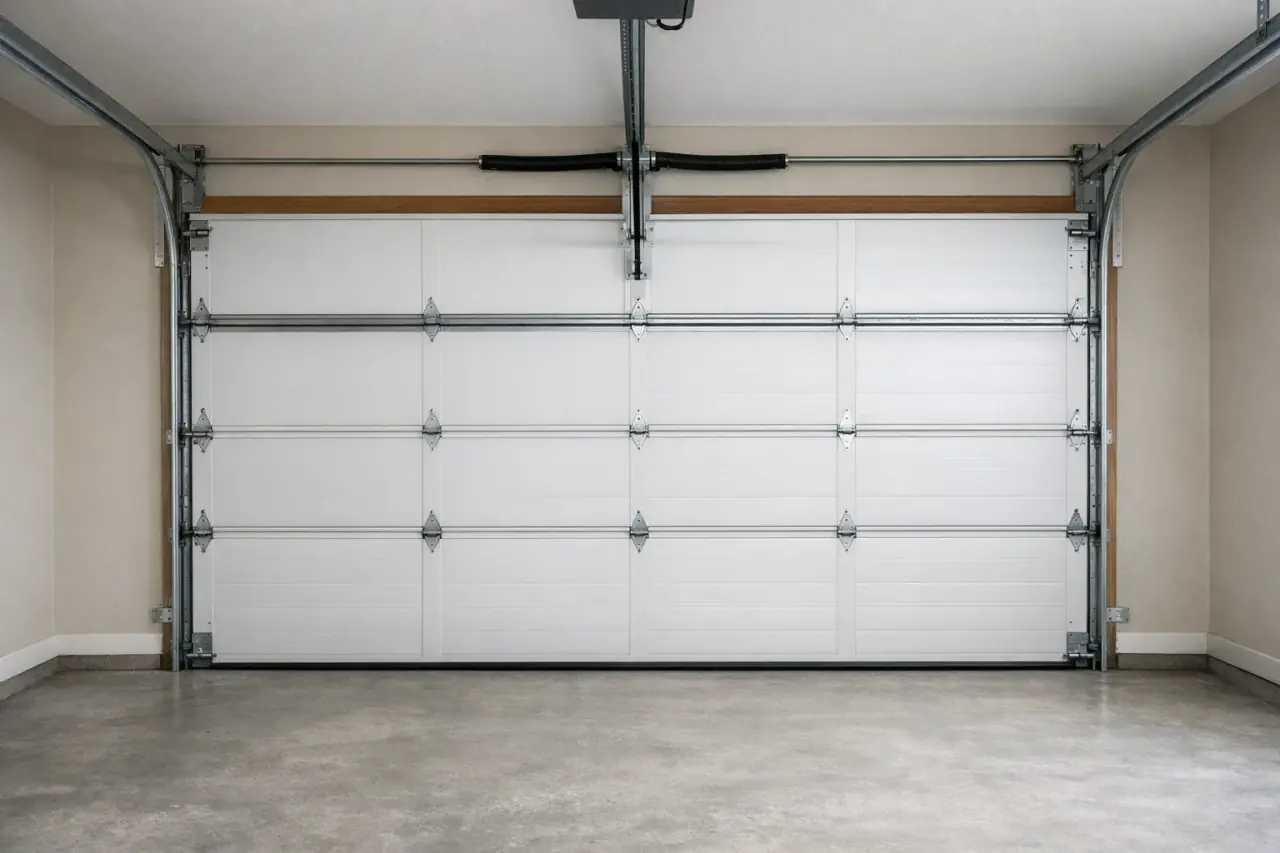
What does a sagging or bent garage door look like?
A sectional door is a stack of hinged horizontal sections rolling on a track at each side. When every part is stiff enough for the span, it stays flat up or down. When something gives, you'll usually see one of these:
- The middle droops when the door is up, sometimes low enough to worry about a roof rack.
- The top section folds inward in a shallow V or crease, usually centered on the opener arm's bracket.
- One joint dips, so the gap between two sections opens unevenly.
- The closed door bows, letting daylight in at the top corners or along the side seals.
- Paint cracks in a straight line across a section where the steel or wood flexes on every cycle.
If a vehicle caused the bend, start with what to do after a car hits the door, and if rollers have left the track, see the off-track guide. And if "sags when open" means the door slowly drifts back down, that's a spring balance problem, covered in the springs section below.
Why does a garage door sag in the middle when it's open?
Once it's open, the door lies nearly flat on the horizontal tracks, held up only at its two edges where the rollers ride. Everything between is effectively a bridge, and the wider the door, the more it droops under its own weight. A two-car door spans roughly twice the distance of a single, and lightweight single-layer steel has little stiffness to resist it.
That's why manufacturers fit struts: long steel channels, usually U-shaped, fastened across the inside face of a section to keep it straight. A strut can also go missing: never installed, left off after a section swap, or removed for insulating or painting and never refitted. A door that was flat for years and suddenly sags may have a strut that has come loose at one end.
Why is the top section of the garage door bent?
A trolley-style opener's arm attaches to one bracket near the top center of the door. The opener pulls on that single point every time the door opens and pushes on it every time it closes. On thin steel, that concentrated force flexes the metal until it folds.
The Door & Access Systems Manufacturers Association (DASMA), a trade association of door and opener makers, advises reinforcing the top section per the door maker's instructions when an opener is connected, for example with horizontal reinforcement near the opener bracket. A door that got its opener years after it was installed deserves a close look, since that reinforcement may never have been added.
Two opener settings make the damage worse:
- A close limit set too far. If the opener keeps driving after the bottom seal touches the floor, it shoves the top section inward at the end of every close. A bow that looks worst when the door is fully shut often traces back to this.
- Force turned up to move a heavy door. That masks a spring problem, lets the opener push harder than the section can take, and dulls the safety reversal.
See the opener troubleshooting guide for settings, and the opener installation checklist if you're adding an opener to an older door.
How can weak springs bend a garage door?
The springs, not the opener, are supposed to carry the door's weight; on a balanced door, the opener mostly steers. As springs lose tension with age, the opener supplies the difference through that same small bracket, bending the top section slowly and wearing out its own motor and drive. Signs that springs are involved:
- The door feels heavy when you lift it by hand with the opener disconnected
- It won't hold still when you let go partway up; DASMA's homeowner checklist expects a working door to stay put about three to four feet above the floor
- The opener sounds labored, slows near the top, or reverses for no obvious reason
- A torsion spring shows a gap between its coils
More warning signs are in how long garage door springs last. Repairing the bent section without fixing weak springs only resets the clock.
Can worn hinges make the door sag?
Yes, and it can look like the whole door sagging. End hinges join the sections and hold the rollers, while center hinges carry the middle of each joint. When pivot holes wear oval, a leaf cracks, or screws strip out of the steel, the joint loosens and the sections drop out of line.
Look for crooked hinges, metal dust around the pivots, screws backing out, and cracks spreading from screw holes. Where screws have torn through thin steel, the section may need a reinforcing plate or replacing, not just a new hinge.
End hinges on many residential doors are graduated and stamped with a number, and the number isn't the same at every joint. Read the number on the old hinge and match it, so the roller sits where the track expects it. Worn rollers are usually replaced at the same time.
Why do wood garage doors warp and sag?
Wood moves with moisture. A section that soaks up water swells, then shrinks as it dries, and repeated cycles can twist it, open its joints and loosen the screws holding hinges and brackets. Because wood doors are heavy, a joint that starts to give tends to keep going.
DASMA's wood finishing guidelines call for all six sides of every section to be finished, especially the inside surface and edges, where bare wood lets moisture in. Its inspection sheet flags the bottom section for water damage and the top section where the opener and top roller brackets fasten, and suggests an inspection generally every 12 to 18 months.
Refinish bare or weathered areas promptly, inside and out, using these painting and refinishing steps. DASMA notes that finish applied to an installed door adds weight that may affect how it runs, and that finishing after installation may void the maker's warranty, so read the warranty first. A badly twisted section usually needs replacing, since a strut stiffens wood but can't reliably pull a warped section flat.
How do you figure out what's causing the sag?
You can narrow it down in a few minutes without touching anything under spring tension.
- Watch one full cycle from a safe spot. Note where the door droops, flexes or bows, and keep everyone clear of the opening.
- Close the door and unplug the opener. Nobody can start it by remote while you're looking closely.
- Count the struts. Note which sections have a steel channel across the inside face and whether every fastener is in place.
- Inspect the opener bracket. Look for a strut or plate behind it, screws pulling out, and creasing or cracking around it.
- Go joint by joint. Check each hinge for cracks, wobble, missing screws and oval holes, and on wood doors look for soft spots, splits and bare edges.
- Test the balance only if the springs and cables look intact. With the door down, pull the opener's release cord; DASMA cautions that a disengaged door may unexpectedly start to open. Without straining, raise it by hand until the bottom is three to four feet off the floor, then ease your grip. If it drops or rises, the springs need a technician. Reconnect the opener when you're done.
Then match what you found:
| What you find | Likely cause | Usual fix |
|---|---|---|
| Middle droops only when the door is open | No strut, or too few for the door's width | Add struts, then rebalance the springs |
| Crease centered on the opener bracket | Unreinforced top section, or close limit or force set too high | Strut and reinforced bracket on the top section; reset the opener; new section if creased |
| One joint dips or gaps | Worn or cracked hinges, stripped screws | New hinges; plate or replace the section if the steel is torn |
| Door feels heavy and won't hold position | Weak or mismatched springs | Spring adjustment or replacement |
| Wood section twisted or soft | Moisture damage | Refinish; replace the section or door if rotted |
What fixes a sagging or bent garage door?
Struts and opener reinforcement
A strut is the standard fix for a door that sags when open. It's fastened across the section at the end and center stiles, the vertical reinforcements inside a steel section, so the load goes to the strongest parts of the door. For a bent top section, the strut runs along the top edge and the opener bracket is mounted to spread its pull across it, per the door maker's instructions. A slight bow can often be drawn back into line as the strut is tightened; a crease can't.
The catch is weight. Springs are sized for the door as it was, so added steel can leave it heavy and the opener straining. Whoever adds struts should recheck the balance, adjust the springs as needed, and reset the opener's close limit and force.
Hinges, sections and springs
Swapping upper hinges is a careful, one-at-a-time job with the door closed. The bottom corner brackets are different: they anchor the lift cables under spring tension, so leave anything attached to them to a technician.
A top section that is creased, cracked or torn around the opener bracket usually needs replacing if a matching one is still made; the broken panel guide explains matching. When weak springs caused the bend, spring repair belongs in the same job.
A new door
When several sections sag, wood is rotting or the model is discontinued, weigh replacement with the repair-or-replace guide. A double-skin insulated steel door is generally stiffer than a single sheet of steel, which helps on wide openings; the materials comparison covers the trade-offs.
Is it safe to keep using a sagging garage door?
Safety: Garage door springs, and the cables and brackets they pull on, are under high tension and can cause serious injury. Never loosen the bottom corner brackets, the cables or any spring hardware to straighten a section or fit a strut, and never try to adjust or replace torsion springs yourself. DASMA's homeowner checklist warns not to remove, repair or adjust springs or parts and mounting surfaces such as wood blocks, steel brackets and cables, and leaves that work to a trained door systems technician.
A slight droop on a door that still runs smoothly is usually fine for careful use until the repair. Stop using the opener if the top section is creased or cracked, its bracket is pulling loose, a hinge has broken, or the door binds or travels crooked, because a section that fails mid-travel can jam the door or pull rollers from the track.
When should you call a professional?
A careful homeowner can handle the inspection above, snug loose hinge screws above the bottom section of a steel door with the door closed and unplugged, keep a wood finish intact, and reset the opener's close limit from its manual if the bow appears only at full close. On a wood door, DASMA's advice is stricter: if any hardware looks loose, stop using the door until a trained technician inspects it.
Call a technician when the top section is creased or cracked, struts need adding or reattaching, the balance test fails, hinges have torn out of the steel, or wood is splitting near its hardware. A tune-up visit covers hinges, balance and hardware, and section work is handled as panel replacement. Estimates are free and same-day service is available in most areas; request a visit and say where the door bends so the right parts come along.
Key takeaways
- A door that sags in the middle when open usually lacks struts for its width.
- A bent top section points to an unreinforced opener connection, an opener pushing too hard, or weak springs.
- Worn hinges cause dips at the joints; moisture-damaged wood twists and loosens its hardware.
- Struts add weight, so the springs need rebalancing by a technician afterward.
- Never loosen bottom brackets, cables or springs to straighten a door.