
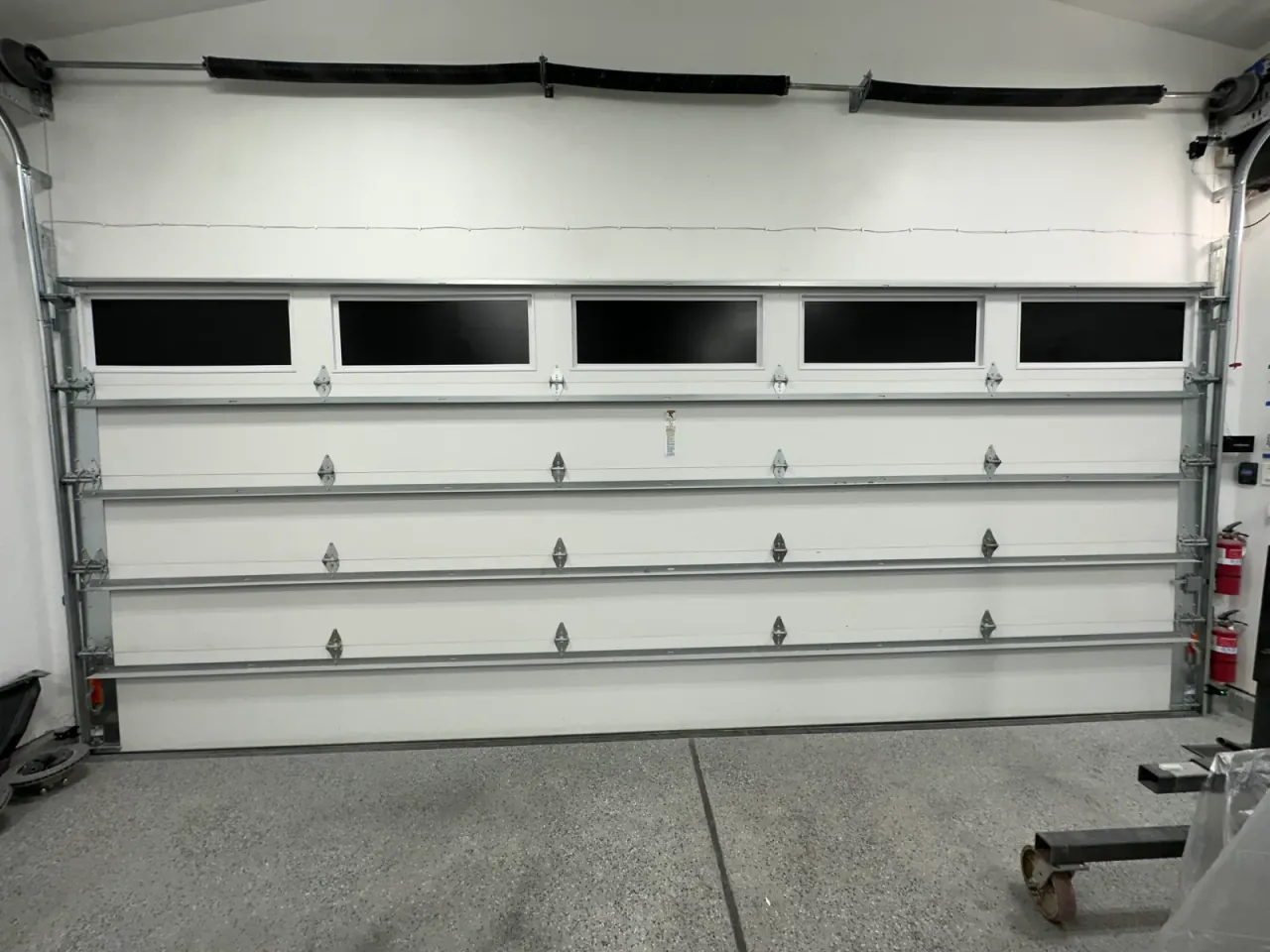
Can you replace only the broken spring?
Physically, yes. A technician can take the broken spring off the shaft, fit a new one of the same specification and rewind the system. Whether you should depends on how many springs the door has and how old the survivor is. On a single-spring door there is no decision to make: one spring broke, one spring gets replaced. On a two-spring door the question is real, and the trade recommends replacing both for reasons that are mostly about money and timing rather than safety.
The question comes up constantly because companies price the two options so differently. In October 2026, one Tampa installer advertised springs from $404 for a single and from $445 for both, while a Miami Lakes company listed $409 for one spring and $669 for a pair. Those gaps, roughly $40 in one case and $260 in the other, are why homeowners ask whether the second spring is necessary or an upsell.
How many springs does your door have?
Stand inside with the door closed and look just above the opening.
- One coil on the shaft, usually to one side of the center bracket: a single-spring torsion door. Common on eight- and nine-foot doors and on lighter sixteen-foot doors.
- Two coils, one on each side of the center bracket: a two-spring torsion door. Standard on heavier double doors, insulated doors and most impact-rated doors.
- No coils visible, but a round tube above the door: an enclosed system such as Wayne Dalton's TorqueMaster, with one or two springs hidden inside; our TorqueMaster guide explains how those are serviced.
- Springs running along the horizontal tracks: extension springs, always fitted in pairs, one per side.
Extension springs are the simplest case. They work independently, one on each side, and replacing only one leaves the door pulling unevenly, so they are changed as a pair as a matter of course. The rest of this guide is about torsion doors, where both springs sit on one shaft.
Why do technicians recommend pairs on two-spring doors?
Three reasons, in order of importance.
- Both springs have the same mileage. They went on the shaft the same day and have twisted and relaxed the same number of times. Spring steel fails from fatigue, and fatigue is a function of cycles. When one breaks, the other has spent most of its life. It will not fail tomorrow, but months rather than years is the realistic expectation.
- Labor is the expensive part. Releasing tension, removing a spring, fitting the new one and winding the shaft takes the same time whether one spring or two comes off. The second spring adds its parts cost and a few minutes. A second visit a year from now repeats the whole bill.
- A matched pair balances properly. Two springs of identical specification share the load evenly. A new spring next to a tired one of the same nominal size works, but the pair delivers less total lift than the door was designed for, and the opener quietly takes up the difference until the old spring finally goes.
There is a fourth reason some companies cite: a longer warranty that applies only when both springs are replaced. That is their policy rather than a mechanical fact, but it does tell you how little confidence installers have in a lone survivor.
When is replacing just one spring the right call?
A pair is the default, not a rule. One spring makes sense when:
- The door has one spring. The most common case by far.
- The other spring is nearly new. If a previous repair replaced only one spring, you may have a two-year-old spring beside a ten-year-old one. When the old one breaks, replacing it alone is reasonable, provided the technician matches the specification of its newer partner.
- A spring failed early for a reason other than fatigue. A manufacturing flaw or damage from a localized rust spot can take out a spring long before its partner is tired. Ask the technician whether the break looks like fatigue or something else.
- Money is tight today and the door is a candidate for replacement soon. Spending on one spring to keep an aging door running for another season can be sensible if a new door is in the plan. Our repair-or-replace guide walks through that decision.
In every one of these cases the replacement must match: same wire diameter, inside diameter, length and wind direction as the spring it joins. Guessing produces a door that will not hold position and an opener working far harder than it should.
What do cycle ratings have to do with it?
One cycle means the door went up and came down once, and standard residential springs are typically rated around 10,000 of them. Ratings follow from design: a spring wound from heavier wire, and made longer to deliver the same lift, is stressed less on every cycle and lasts more of them. High-cycle springs rated for 25,000 cycles or more are available for most torsion doors.
Two points matter for the one-or-two decision. First, a pair ages at the same rate, which is the whole argument for replacing both. Second, when you do replace a pair you get a free choice of rating, and the sensible move is to give both springs the same one. A 25,000-cycle spring beside a 10,000-cycle spring buys you nothing, because the weaker spring sets the date of the next failure. For the full arithmetic of cycles into years, see our spring lifespan guide.
Does replacing both springs cost twice as much?
No. On our price list, a matched pair sits at the upper end of the spring replacement range rather than at double the single price. That range includes the visit, the parts, the labor and the balance test, with no trip charge and no after-hours surcharge; the current figures are on our pricing page.
The market tells the same story in different numbers. In October 2026, the two Florida companies that advertised both prices put the pair premium at about $40 and about $260 over the single-spring price. Even at the top of that spread, a pair today is cheaper than a single today plus another full visit when the survivor breaks. If you are weighing quotes, compare the pair price to the pair price and ask what cycle rating each company is quoting. Our guide to spring replacement costs in Miami shows how widely headline prices varied in October, and the national ranges for singles and pairs sit in our repair cost guide.
What should be checked while the springs are off?
A spring replacement is the one moment the whole counterbalance system is unloaded, which makes it the cheapest time to deal with anything else that is worn:
- Lift cables. Frayed strands or rust at the bottom bracket mean the cables are replaced now, at the cost of the part alone; a cable that snaps later is its own emergency, as our cable replacement guide explains.
- Cable drums. Grooves worn smooth or a cracked flange.
- Center and end bearings. A seized center bearing can score the shaft and chew through a new spring's stationary cone.
- Rollers and hinges. Worn rollers add drag that the new springs then have to overcome.
Each item should be quoted separately and approved before it is touched. A good technician points them out and lets you decide; a poor one either ignores them or presents them as mandatory.
What do we recommend?
Our practice follows the reasoning above. On a two-spring door whose springs have aged together, we recommend replacing both, sized to the door's measured weight and height, with the same cycle rating on each side. On a single-spring door we replace the one spring, and on a heavy double door carrying a single spring we may suggest moving to two so each works under less stress. When the garage doubles as the front door, high-cycle springs are worth the modest extra cost. Either way, you get the specification and the price in writing before we start, and the repair carries our six-month warranty.
Safety: Whichever option you choose, the work is not a do-it-yourself job. A wound torsion spring holds the door's full weight as stored twist, and a slipped winding bar can break bones. Do not loosen set screws on the shaft or try to add tension to a surviving spring to get by. Leave the door down and call.
When should you call a pro?
- One spring has snapped and the door will not lift, or lifts a few inches and stops
- The door drifts up or sinks when you raise it halfway by hand with the opener disconnected
- The springs came with the house, the door runs several times a day, and you would rather schedule the pair than wait for the bang
- A previous repair left one new spring beside one old one and you want the system matched
Our spring replacement service handles singles, pairs, high-cycle upgrades and conversions. A balance check is part of every maintenance visit, and a door stuck open with a broken spring goes to emergency dispatch at any hour. Estimates cost nothing; request one here.
Key takeaways
- One spring can be replaced on its own; on a single-spring door that is the job.
- Where a torsion door carries two springs, both have the same cycle count, so the survivor is usually close to failing and a pair is the better value.
- Labor is the same for one or two springs; the pair adds only the second spring's parts cost.
- Replace a single when the door has one spring, the partner is nearly new, or the break was not fatigue.
- Give both springs the same cycle rating, have cables and drums checked while the tension is off, and never do the work yourself.