
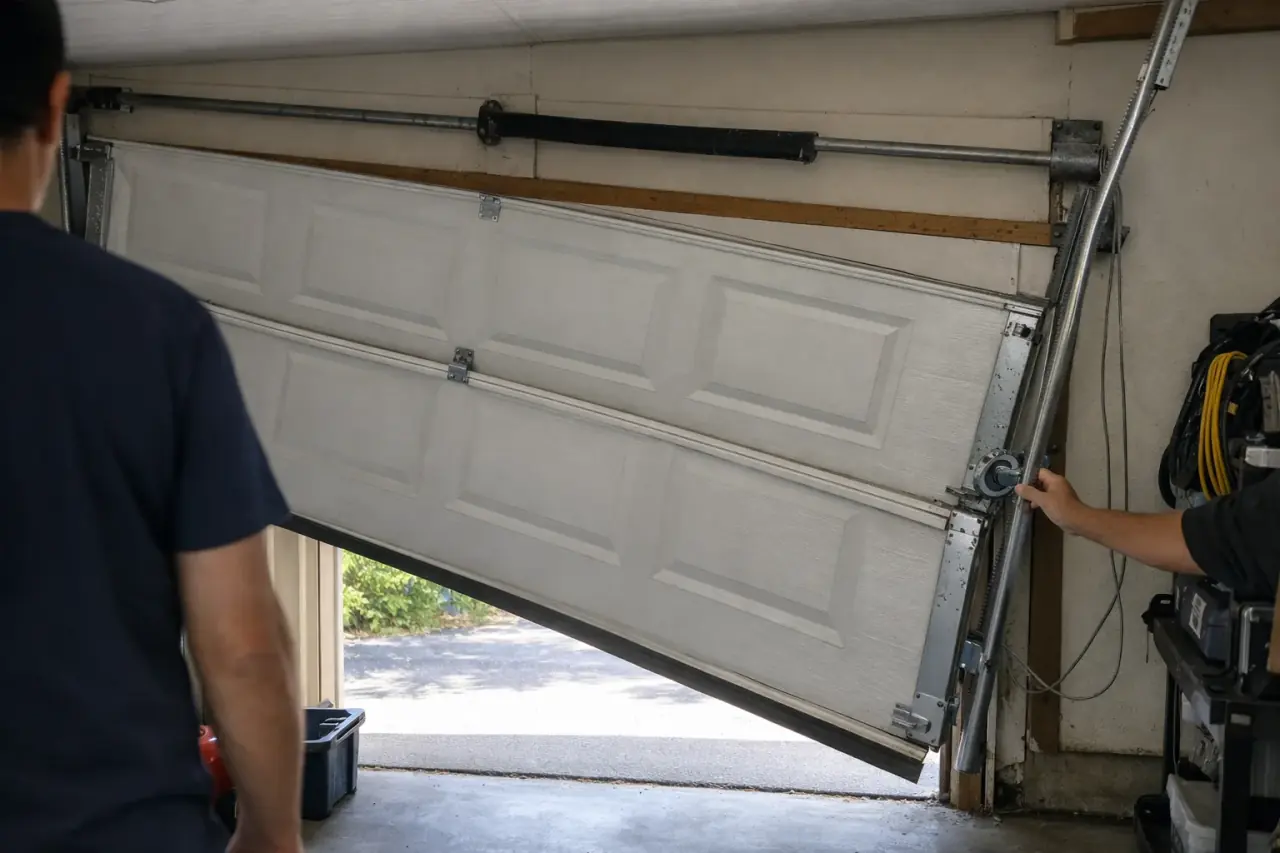
How do you know your garage door is off track?
Sometimes it's dramatic: a crunch, a bang, and a door hanging at an angle. Other times one roller slips out quietly and you only notice the door looks a little crooked. Signs that a door has left its track include:
- One or more rollers visibly outside the track channel
- The door sitting crooked, with one side higher than the other
- A gap opening up along one side of the door
- The door stuck partway and refusing to go up or down
- A kinked or bowed section of track
- A lift cable hanging slack or wrapped unevenly on its drum
- Sections bowing outward or inward
There are usually warning signs before it gets that far. Watch for rollers that scrape or tilt in the track, a door that shudders at the same spot each time, track brackets working loose from the wall, or a door that rubs the jamb on one side.
What knocks a garage door off its track?
A door that jumps its track almost always has a reason, and finding it matters as much as the repair. The common causes:
- Impact. A bumper, a lawn mower or a bike can push the bottom section or a vertical track out of line.
- An obstruction while closing. If the door lands on something and the opener keeps pushing, rollers can pop out, especially on older openers or ones with force set too high.
- A broken lift cable. When one cable snaps, that side of the door drops and its rollers twist out of the track; more on lift-cable failures.
- A broken spring with the opener still running. The opener tries to lift a door that's suddenly much heavier, often unevenly.
- Loose or misaligned track. Vibration loosens the lag screws holding track brackets to the jamb, and rotted jamb wood can let them pull out entirely. The horizontal tracks also need solid rear hangers.
- Worn or broken rollers. Cracked wheels, seized bearings and bent stems let a roller ride up and out. Bare plastic rollers without bearings tend to wear out first, which is why roller type matters.
- Tracks spread too far apart or pinched too close, which leaves rollers either loose or binding.
What should you do right away?
- Stop operating the door. Don't press the remote or wall button again.
- Unplug the opener so no one runs it by accident.
- Clear the area. Keep people, pets and vehicles away from the door and out from under it.
- Leave the emergency release alone while the door hangs partway open or crooked. Disconnecting the opener can let an unbalanced door fall.
- Look for the cause from a safe spot. Check for a slack or snapped cable, a split coil on the torsion spring, a bent track or a broken roller. Take photos.
- Secure the house. If the door is stuck open, lock the interior door from the garage and keep cars out of the doorway.
- Call a technician and describe what you see.
Which track problems can you fix yourself?
Some track maintenance is fine for a homeowner, as long as the door is fully closed, the opener is unplugged and the rollers are all seated in the track.
- Clean the tracks. Clear cobwebs, grit and hardened old grease from both channels with a cloth and a household cleaner, then dry them. Don't grease the tracks; rollers are supposed to roll.
- Tighten loose track brackets. Snug the bolts and lag screws that hold the vertical tracks to the jamb. If the screws spin without tightening, the wood behind them is stripped or rotted and needs a proper repair.
- Check the vertical tracks with a level. They should be plumb, and the gap between the track and the edge of the door should be consistent from bottom to top. Note what you find and share it with your technician.
- Look at the rollers. Wobbly, cracked or flat-spotted rollers should be replaced before they cause a derailment. Top and middle rollers can be a careful DIY job; bottom rollers can't.
Safety warning: Do not try to pry rollers back into the track, bend a track with the door raised, or loosen the two brackets where the cables attach at floor level. Those anchor points hold back the springs' pull whenever the door is down. On extension-spring doors, the rear track hangers and spring anchors are also loaded.
Leave these to a professional: re-seating rollers, straightening or replacing bent track, any work with the door partly open, and anything involving a loose cable or a broken spring.
How do technicians fix an off-track door?
A typical off-track repair follows this pattern:
- Secure the door with clamps or supports so it can't move or fall.
- Release spring tension if a cable has come off its drum or snapped.
- Guide the rollers back in, often by opening the track ends slightly or removing a short track section, then closing it back to spec.
- Straighten or replace bent track. Badly kinked track is replaced rather than hammered back into shape.
- Replace damaged parts: rollers, hinges, cables, drums or a creased door section.
- Realign the tracks so the vertical tracks are plumb, the horizontal tracks are parallel and properly supported, and the spacing to the door is even on both sides.
- Rebalance and test. Spring tension is checked first; then the opener's force and limit settings and its reversing function are tested and reset.
The last step matters. A door that has been off track often needs its opener settings relearned, and a door that's out of balance will soon derail again.
How much does garage door track repair cost?
Here's what homeowners commonly pay nationally; local labor rates and damage found on site will shift it.
| Track work | Common U.S. price range |
|---|---|
| Re-seat door and realign track | Roughly $150 to $350 |
| Replace a bent vertical or horizontal track section | Roughly $150 to $400 for the track work |
| Off-track repair plus cables | Cable replacement on top, usually cheaper than a separate visit |
| Off-track repair plus a damaged section | Section cost on top; see bent-section decisions |
Your bill climbs with the severity of the bend, any cables, rollers or sections damaged in the derailment, the door's size and weight, a night or weekend call-out, and what labor costs in your area. Other jobs are priced in our wider look at repair bills.
How can you keep the door from coming off track again?
- Replace worn rollers before they fail, ideally with sealed-bearing nylon rollers.
- Lubricate roller bearings and hinges a few times a year, and keep the tracks clean.
- Tighten track brackets once a year; vibration loosens them over time.
- Test auto-reverse monthly with a 2x4 laid flat under the door, so the opener backs off instead of shoving the door onto an obstruction.
- Watch the cables and springs. A fraying cable or a weakening spring is a derailment waiting to happen.
- Give the door some room. Park far enough from the door that a bumper can't nudge it, and keep bikes and bins away from the tracks.
- Have the hardware looked over yearly during a scheduled preventive visit before small looseness becomes a derailment.
How soon do you need a technician?
Right away if a roller is out of the track, the door hangs crooked, a track is kinked or a cable has gone slack. A door stuck open or leaning in its opening is an emergency call at any hour, while new track, rollers and cables are handled through track and hardware replacement. Get in touch and describe what you're seeing.
Key takeaways
- An off-track door can fall: stop using it, unplug the opener and keep clear.
- Common causes are impacts, obstructions, snapped cables, broken springs, loose track and worn rollers.
- Cleaning tracks and tightening loose brackets are safe DIY tasks with the door closed.
- Re-seating rollers and straightening track require a technician.
- Typical U.S. cost to re-seat and realign is roughly $150 to $350, more with damaged parts.