
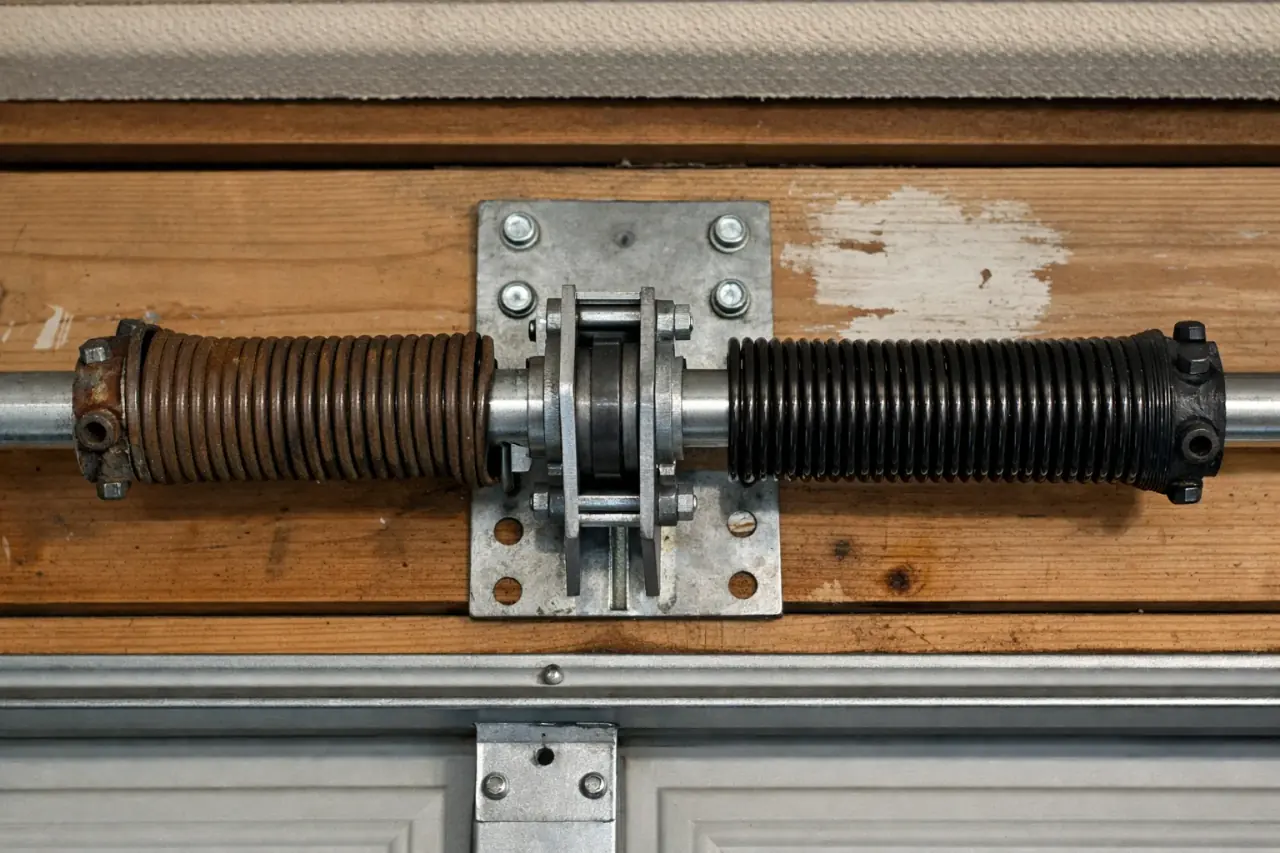
How are garage door springs rated?
Springs aren't rated in years. They're rated in cycles, and a cycle is one full open and one full close. Each time the door runs, the steel twists or stretches and relaxes again, and every repetition adds a tiny amount of fatigue. Eventually a microscopic crack forms and the spring snaps.
The rating comes from the spring's design. For any given door, a technician can choose from many spring combinations that produce the same lifting force. A spring made from heavier wire and wound longer works under less stress per cycle, so it lasts more cycles. That's all a "high-cycle" spring really is: the same job done by a spring that's less strained.
Common ratings you'll see:
- About 10,000 cycles: the standard for most residential torsion and extension springs
- 15,000 to 25,000 cycles: common high-cycle upgrades for homes
- 50,000 cycles and up: long-life designs, often used on commercial doors and busy homes
How many years is 10,000 cycles?
The math is simple: divide the rating by your cycles per year. This table shows the theoretical life at different usage levels.
| Cycles per day | 10,000-cycle spring | 25,000-cycle spring | 50,000-cycle spring |
|---|---|---|---|
| 2 | about 13.7 years | about 34 years | about 68 years |
| 4 | about 6.8 years | about 17 years | about 34 years |
| 6 | about 4.6 years | about 11.4 years | about 22.8 years |
| 8 | about 3.4 years | about 8.6 years | about 17 years |
| 10 | about 2.7 years | about 6.8 years | about 13.7 years |
Treat the long numbers in the right-hand columns as a ceiling, not a promise. Past 15 or 20 years, rust, wear on the shaft and bearings and changes to the door usually end a spring's life before the cycle count does.
Counting your own cycles: for a typical weekday, count every time the door opens. Commutes, school runs, errands, taking the trash out through the garage and kids coming and going all add up. If the garage is the main way in and out of the house, six to ten cycles a day isn't unusual.
What shortens a garage door spring's life?
The rating assumes good conditions. Real garages vary, and these factors pull the number down:
- Heavy use. It's the biggest factor by far. A garage that serves as the family's main entrance can rack up cycles several times faster than one opened once or twice a day.
- Rust. Humid climates, the salt air that reaches garages across South Florida, and road salt in snowy regions pit the steel. Pits concentrate stress, and rusty coils grind against each other.
- Cold. Cold doesn't add cycles, but stiff grease and frozen seals make every cycle harder, and a spring that's already near the end of its fatigue life often gives out on a frigid morning. The cold-weather care guide covers what to do before the first freeze.
- No lubrication. Dry coils rub as they wind and unwind, adding friction and wear.
- Added weight. Insulation kits, new windows, a heavier replacement section, extra coats of paint or a wood door that soaks up moisture can all make the door heavier than its springs were sized for.
- Poor balance. A spring that was set with too few or too many turns, or sized wrong to begin with, works harder every cycle.
- Builder-grade minimums. Many new homes get springs that meet the door's needs at the lowest cost, which usually means the standard rating.
What are the signs a spring is near the end of its life?
These are early warnings, before the bang. If you notice them, plan a replacement instead of waiting for a failure:
- The door won't hold its position. Disconnect the opener with the door down and raise the door to the halfway point by hand. If it sinks or drifts upward when you let go, spring tension has changed.
- The opener sounds strained or the door moves more slowly than it used to.
- Visible rust along the coils, especially near the winding cones.
- Extension springs that don't close up. When the door is open and extension springs are at rest, their coils should sit close together. Visible gaps mean the spring has stretched out.
- Creaking or popping from the springs that comes back soon after lubricating.
- Age and history. Original springs on a busy door that's seven or more years old are living on borrowed time. If one spring of a pair just broke, the other is close.
Once a spring actually breaks, the signs are hard to miss; what a broken spring looks like and how it's replaced is covered separately.
How can you make garage door springs last longer?
You can't stop fatigue, but you can avoid adding to it.
- Lubricate the springs two to four times a year. A light coat of garage-door lubricant along the coils reduces friction and slows rust. Wipe off the excess. Products and technique are in our spray-by-spray lubrication notes.
- Check the balance monthly. It takes a minute as part of a quick monthly inspection. If the door drifts, have a technician adjust the tension.
- Fight rust where it starts. Keep the garage dry and ventilated, and in coastal areas ask about springs with a protective coating. Coated springs resist corrosion, though they may cost more; ask your technician about the trade-offs.
- Tell your technician before you add weight. If you insulate the door, add windows or replace a section, the springs may need re-sizing; insulation kits and R-values touches on the weight question.
- Cut unnecessary cycles. Use the side or front door for quick trips when it's convenient.
- Choose high-cycle springs at the next replacement, especially if the garage is your main entrance.
Are high-cycle springs worth it?
For a lot of households, yes. Consider a family that runs the door six times a day. A 10,000-cycle spring would last a bit under five years. A spring rated around 25,000 cycles would last over 11 years in theory, and the price difference between the two is usually modest compared with the cost of a second service call. Typical national prices for standard and high-cycle springs are in our garage door spring replacement cost guide, and our own range is on the pricing page.
High-cycle springs make the most sense when:
- The garage is the main way in and out of the house
- You plan to stay in the home for many years
- You'd rather pay a little more once than risk being stuck again
They make less sense on a door you're planning to replace soon, or on a garage that's used once or twice a week. One practical limit: longer springs need room on the shaft between the drums, so not every door can take the longest designs.
Do both springs wear out at the same time?
On a two-spring torsion door, both springs share the load and run the same number of cycles. They don't break on the same day, but they age together. When one fails, the other has typically used up most of its life too, which is why technicians replace them as a pair. The same goes for the two extension springs on either side of a door.
Do weak springs affect the opener?
Yes. As springs lose tension, the opener has to lift more of the door's weight. That wears out drive gears, belts and motors faster, and can make an aging opener look like the problem when it's really the springs. A door that's properly balanced is the cheapest way to extend an opener's life, and it's the first thing to rule out when an opener starts acting up.
When is it time for a spring inspection?
When your door fails the balance test, the springs look rusty or creak, or they're original on a busy door that has outrun its rated cycles. A technician can size high-cycle replacement springs for your exact door, and a spring and balance check is built into every maintenance visit. Coverage questions are answered in how door warranties treat springs. Estimates are free; ask for one.
Key takeaways
- Springs are rated in cycles; standard springs are typically good for about 10,000.
- Divide the rating by your yearly cycles: four a day means roughly seven years.
- Rust, cold, dry coils, added door weight and poor balance all shorten spring life.
- Lubricate springs a few times a year and check the door's balance monthly.
- High-cycle springs usually pay off when the garage is your main entrance.