
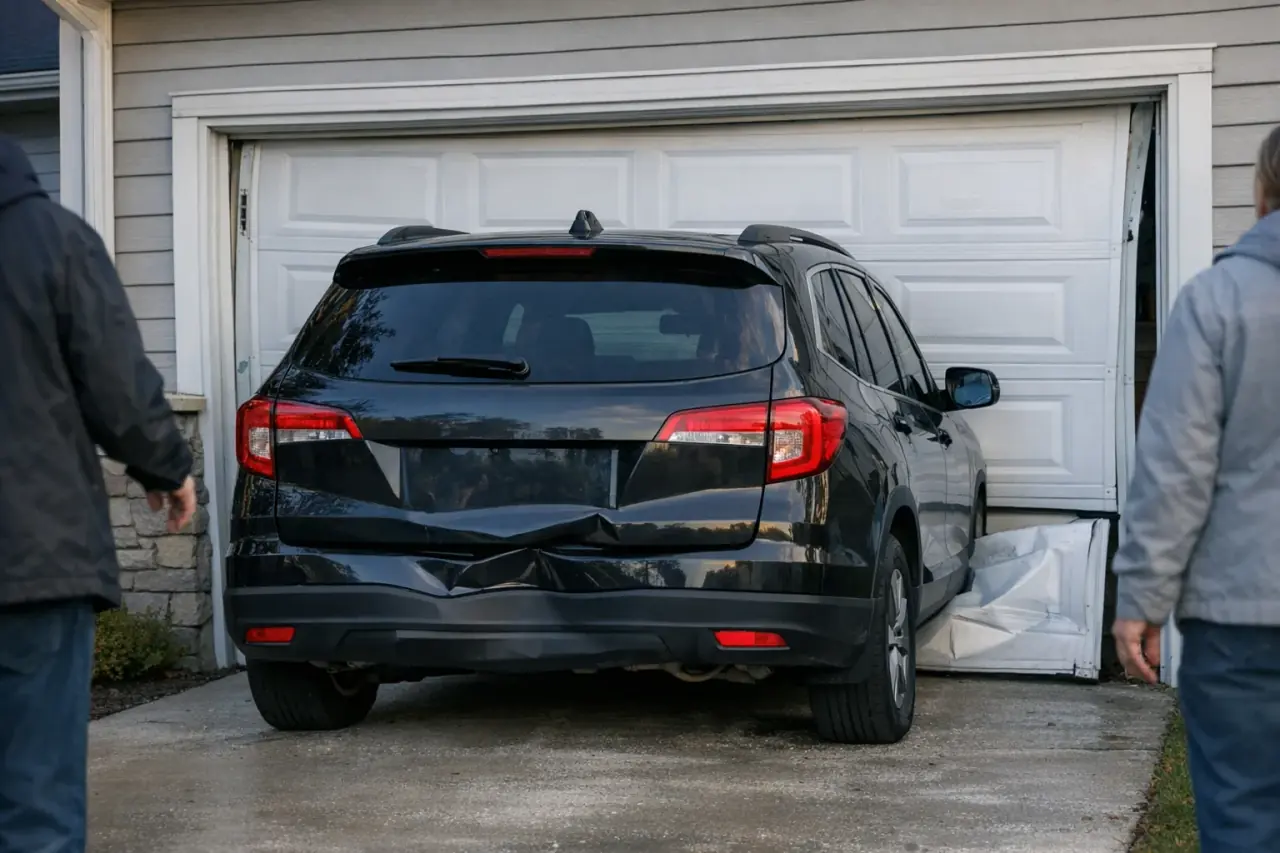
What should you do right after a car hits your garage door?
Backing out before the door is fully up, misjudging the opening, or a foot slipping off the brake: it happens in a second, and the door almost always loses. The next few minutes matter more for safety than for the repair bill.
- Make sure nobody is hurt. If the car went through the wall or the frame around the opening is cracked, keep everyone out of the garage until the structure has been looked at.
- Leave the opener alone. Don't press the wall button or the remote to "see if it still works." Unplug the opener from the ceiling outlet so nobody else tries.
- Think before you move the car. If the bumper is clear of the door, you can pull forward or back slowly. If the car is wedged under the bottom section or the door is resting on it, leave it: moving it can let the door drop or rip it out of the tracks.
- Take photos before anything changes. Shoot the door from outside and inside, both tracks, the bottom corners where the cables attach, the springs above the door, the opener rail and the car's position.
- Secure the house. When the door won't close and the garage connects to your home, lock the interior door and move valuables out of sight.
- Write down the details. Note the time, who was driving, and, if it was someone else, their name, insurer and plate number.
- Call for an inspection. Describe what you see: dents, a crooked door, a loose cable, a bent track or a damaged opener. That tells the technician which parts to bring.
Our page on handling other garage door emergencies covers stuck-open doors and power outages if you're dealing with those too.
How can you tell how badly the door is damaged?
From a safe spot, compare what you see with this table. Several of these often show up together after one impact.
| What you see | What it usually means | Run the door? |
|---|---|---|
| A shallow dent, door still runs smoothly | Cosmetic panel damage | Only after a quick inspection |
| A crease across a section, or a split where hinges bolt on | Structural damage to that section | No |
| Bottom section pushed in, rollers out of the track | Door partly off track | No |
| Track bent, or track brackets torn from the wall | Door can bind or fall | No |
| Cable slack, frayed or off its drum | Lifting system compromised | No |
| Door hanging lower on one side | Cable, drum or track problem | No |
| Opener rail bent or its wall bracket pulled loose | Opener damage | No |
| Photo-eye sensors knocked out of line | Door will refuse to close | After realignment |
| Cracked framing around the opening | Structural repair needed first | No |
A door that looks only dented can still hide a problem. Rollers can sit half out of the track, and a hinge can crack on the inside face where you won't notice it from the driveway.
Why is a damaged garage door more dangerous than it looks?
A garage door weighs a lot more than people expect, and the springs carry almost all of that weight. On a working door, the springs, cables, drums and tracks share the load in balance. An impact can knock that balance out without releasing any spring tension at all.
That's why a bent door can bind halfway and then suddenly drop, or why a cable that jumped off its drum can snap free when the door moves. Extension-spring doors add another risk: if the safety cable running through the spring is missing, a broken spring can whip loose.
Safety warning: Don't hammer the track back into shape, pry the bottom section out, or try to push rollers back in while the door is up. Never loosen the bottom brackets at the lower corners; the lift cables attach there and are under spring tension. Leave springs, cables and track realignment to a trained technician.
Does insurance cover a garage door hit by a car?
Coverage depends on who was driving and on your exact policies, so treat this as orientation, not advice. Your declarations page and your agent have the final word.
When you hit your own door
- The door: Homeowners policies typically cover sudden, accidental damage to your home, and an attached garage door is part of the dwelling. A detached garage usually falls under other-structures coverage. There's generally no exclusion just because you caused it.
- The car: Your auto policy's collision coverage pays to repair your car. Liability coverage doesn't pay for damage to your own property.
- Two deductibles: Because two policies are involved, you may owe a deductible on each.
When someone else hits it
A visitor, contractor or delivery driver who damages your door is normally covered by their own auto policy's property damage liability. A company vehicle is usually insured by the business. Get the driver's details at the scene. If it was a hit-and-run, a police report helps if you end up claiming on your homeowners policy.
Is it worth filing a claim?
If the repair estimate lands close to or below your homeowners deductible, many people pay out of pocket. A claim may also affect future premiums. Get the written estimate first, then decide.
What does the adjuster usually ask for?
- Dated photos of the door, tracks, springs, opener and the vehicle
- A written, itemized estimate separating parts and labor
- The door's manufacturer and model, often printed on a label inside one of the sections
- Whether matching replacement sections are still available
If matching sections aren't made anymore, ask your adjuster up front how they handle a door that can't be repaired to match. It's better to know before the work is scheduled.
Should you repair the damaged section or replace the whole door?
When only one or two sections are hurt and the manufacturer still makes them, replacing those sections is usually the simplest fix. Expect the technician to also replace any bent hinges, rollers or track found during the job, then rebalance the springs for the new weight. Our guide to replacing a broken garage door panel walks through the section-versus-door decision in detail.
A full replacement tends to make more sense when:
- Three or more sections are damaged
- The design or color is discontinued, or years of sun have faded the paint
- The door was already old, uninsulated or due for new springs
- The impact also bent the top section, which carries the opener's pull
If you're leaning toward a new door, our repair or replace guide helps weigh age, condition and cost.
The opener deserves a look as well. A bent rail, a cracked trolley or a damaged wall bracket can sometimes be repaired, but an old opener that took a hit may be a good candidate for replacement.
How do you keep it from happening again?
Most impacts come from the door not being fully open, or from someone pressing a button while the car is moving.
- Set the open limit correctly. If the door stops a few inches short of fully open, bumpers and roof racks catch the bottom edge. A technician can adjust the travel limit.
- Use a parking aid. A hanging ball, a floor stop or a laser guide shows drivers where to stop and keeps the bumper away from the door.
- Keep remotes out of reach while driving. Visor remotes and keychain fobs get pressed by accident.
- Wait for the door to stop. Make it a house rule, especially for new drivers.
- Test the safety system monthly. A door that closes on a car is a door that could close on a person. Our safety feature checklist shows the reversal and photo-eye tests.
When should you call a technician?
Call for service the same day if the door is crooked, off track or won't close, if a cable is loose, if the opener rail is bent, or if the house can't be secured tonight. Our 24/7 emergency service handles doors that are stuck open or blocking a car.
For dented or creased sections, see panel and parts replacement. If the door is past saving, we offer free estimates on a new door, or you can request a visit and describe what happened.
Key takeaways
- After an impact, don't run the opener: unplug it and keep people out from under the door.
- Photograph everything before the door or car is moved.
- A dented door can still hide a slack cable, popped rollers or a bent track.
- When you hit your own door, homeowners insurance often covers the door and collision covers the car, with separate deductibles.
- Single sections can be replaced if they're still made; otherwise a new door may be the better repair.