
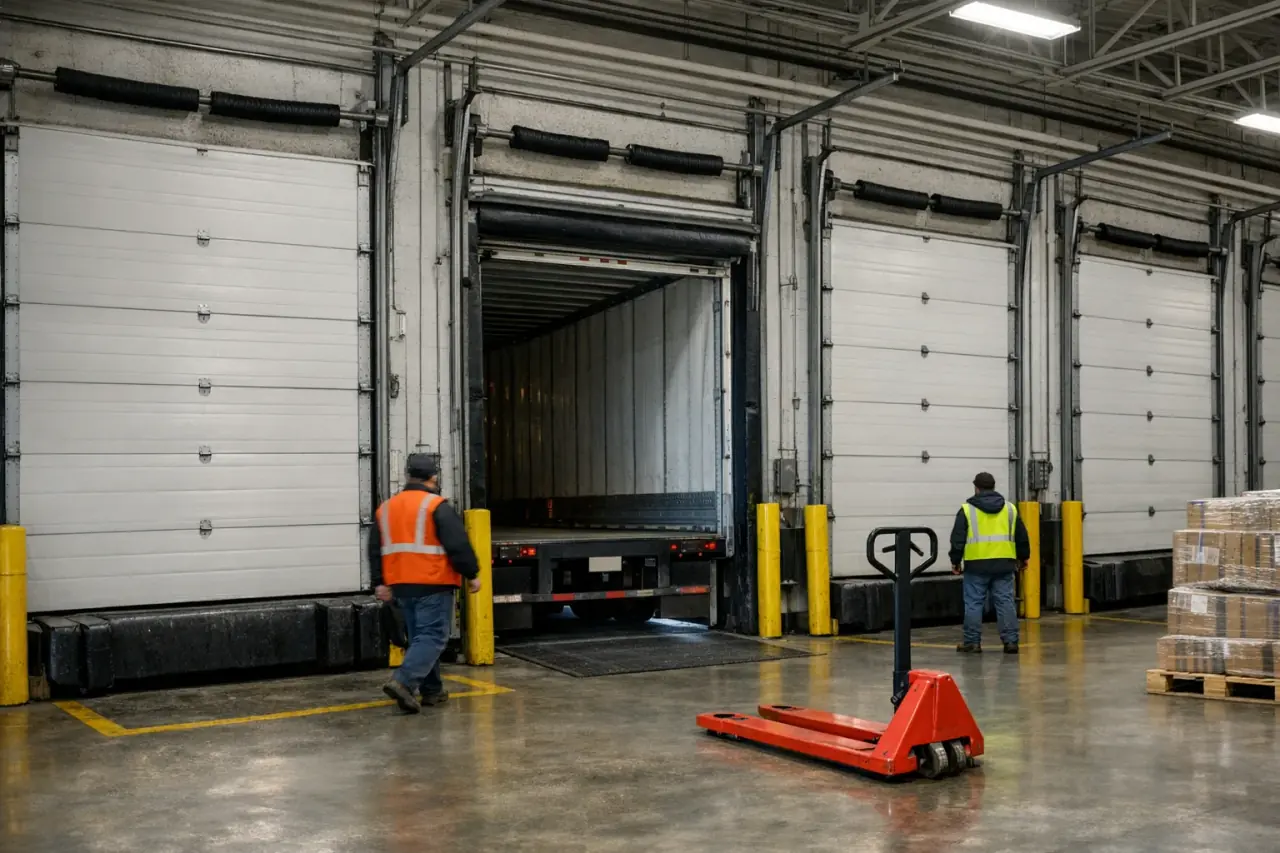
Why do loading dock doors break so often?
A dock door works in the roughest spot in the building. It opens and closes all day, sits a few feet from forklifts and pallet jacks, and faces wind, rain and temperature swings every time a trailer pulls away. Most dock door service calls trace back to three things:
- Impact. Forklift masts, raised forks, tall pallet loads and the occasional trailer clip the bottom section, the tracks near the floor and the jambs.
- Cycling. Springs, cables, rollers and hinges wear by the number of trips the door makes, not by the calendar. A busy dock door can use up a standard spring set far faster than anyone expects.
- The environment. Wind loads on an open dock, salt and moisture tracked in on trucks, and wash-down areas all speed up corrosion at the bottom of the door, where the cables attach.
For an overview of every commercial door type, from rolling steel to high-speed fabric, see our commercial garage door repair guide. This page focuses on the sectional overhead doors found at most truck docks.
What are the most common dock door repairs?
| Problem | Typical cause | What the repair usually involves |
|---|---|---|
| Bent or creased bottom section | Forklift, pallet or load strike | Replacing the section, bottom seal and retainer |
| Kinked vertical track near the floor | Equipment clipping the track | New track section, re-hang and alignment |
| Door off track, rollers out | Impact or a bent hinge | Re-hanging the door, new rollers and hinges |
| Broken spring | Worn out by cycles | New springs, often upgraded to high-cycle |
| Frayed or rusted cable | Moisture and salt at floor level | New cables, and bottom brackets if corroded |
| Door won't close on the operator | Misaligned photo eye or damaged edge sensor | Realignment, new sensor or edge |
| Operator stops, hums or overheats | Worn drive parts, limits or brake | Operator repair or replacement |
| Manual door heavy or won't stay up | Springs losing tension | Spring replacement and rebalancing |
| Daylight around the door | Torn perimeter or bottom seals | New weatherseals |
Several of these often show up together. A single forklift strike can bend a section, kink a track and pop rollers loose at once, which is why a door that "only has a dent" should still be inspected.
What can dock staff safely check before calling?
Good triage saves time on the service call. Keep it to the checks below, with the door closed or fully open and the opening clear.
- Confirm the trailer situation. Make sure the trailer has departed or is properly restrained according to your dock procedure. Where dock equipment is interlocked with the door, the door may be held on purpose.
- Check the controls. Look for a latched emergency stop, a tripped disconnect or a door left in manual mode.
- Look at the photo eyes and edge. Clean the lenses, check their indicator lights and look for a crushed reversing edge or a torn coil cord.
- Walk the tracks. Look for kinks near the floor, loose track bolts, pallet wrap or debris in the track.
- Look at the bottom corners. A slack, kinked or rusty cable at either bottom bracket means the door should not move again until it's repaired.
- Write down what you saw. Note which door, what it does when you press the button and whether anything hit it.
Safety warning: Never stand or let anyone pass under a dock door that's stuck partway, binding or hanging crooked. Don't pull a manual door down by its rope or strap if it feels unusually heavy; that's a spring failure. Don't loosen bottom brackets, set screws or anything on the spring shaft. Those parts hold the door's weight under tension.
How can you keep forklifts and trailers from damaging the door?
Most dock door damage is preventable, and the fixes are cheaper than repeated section replacements.
- Set the open limit to clear your tallest loads. A door that stops a few inches short invites mast strikes. Have a technician adjust it rather than raising loads to "fit."
- Make "fully open" obvious. A light, a sign or a floor marking that tells drivers the door is all the way up cuts down on guesswork.
- Protect the tracks. Track guards and bollards at each jamb take hits that would otherwise kink the vertical track.
- Don't close on a load. Train staff to clear the opening completely before lowering the door, and never to drive under a moving door.
- Consider impact-resistant doors. For openings that get hit repeatedly, ask about dock doors with stronger sections or bottom sections designed to give way and be reset after a strike.
- Inspect after every hit. Logging impacts helps you spot the doors and shifts where damage keeps happening.
Should you repair or replace a damaged dock door?
If an impact bent one or two sections and the manufacturer still makes them, replacing those sections and keeping the door is usually the right call. Springs, cables, rollers, hinges and track are standard repairs on a sound door.
Replacement starts to pay off when:
- Several sections are damaged, or the door has been patched repeatedly
- Matching sections are no longer made
- The building is heated, cooled or refrigerated and the door is uninsulated or poorly sealed
- The same opening takes hits so often that an impact-resistant design would cost less over time
- The operator is obsolete and parts are hard to find
When you replace, take the chance to upgrade to high-cycle springs sized to how often that door actually runs, and add vision windows if staff can't see traffic on the other side.
How should dock doors be maintained?
A busy dock door needs more attention than a rarely used service door. Our commercial repair guide has suggested service intervals by usage. For dock doors specifically, make sure each visit covers:
- The bottom section, bottom seal and retainer
- Track fasteners and alignment at floor level, where impacts land
- Cables and bottom brackets, checked for rust and fraying
- Spring condition and door balance
- Rollers and hinges, especially on the lower sections
- Operator limits, brake and drive parts
- Photo eyes, reversing edges and any interlocks
- Perimeter and header seals
Ask for a written report after each visit, so parts that are wearing can be replaced on a planned day instead of during a breakdown.
What should you have ready when you call for service?
- The dock door number and its location in the building
- The door's size, and the manufacturer from the label if you can find it
- Whether it runs on an operator, a hand chain or a pull rope
- What happened and what the door does now
- Whether the opening needs to be secured tonight
- When a technician can get access, and any site safety requirements
A phone photo of the damage and the door's label helps the technician bring matching parts on the first trip, and the commercial repair range we work from is published in advance.
When does a dock door need emergency service?
Call right away when an open dock door can't be closed and the building can't be secured, when a door stuck closed is holding up shipping or receiving, when the door hangs crooked or a cable has failed, or when the operator smells hot, sparks or keeps tripping its breaker.
For urgent problems, our 24/7 emergency service covers commercial doors. For planned repairs, section replacement and maintenance schedules across several doors, see our commercial door services or arrange a site visit.
Key takeaways
- Impacts and heavy cycling cause most dock door repairs.
- A door that binds, hangs crooked or has a slack cable should be taken out of service until it's repaired.
- Staff can check controls, sensors and tracks, but never springs, cables or bottom brackets.
- Correct open limits, track guards and driver training prevent most strikes.
- Repeated impacts or a temperature-controlled building can make a replacement door the better investment.