
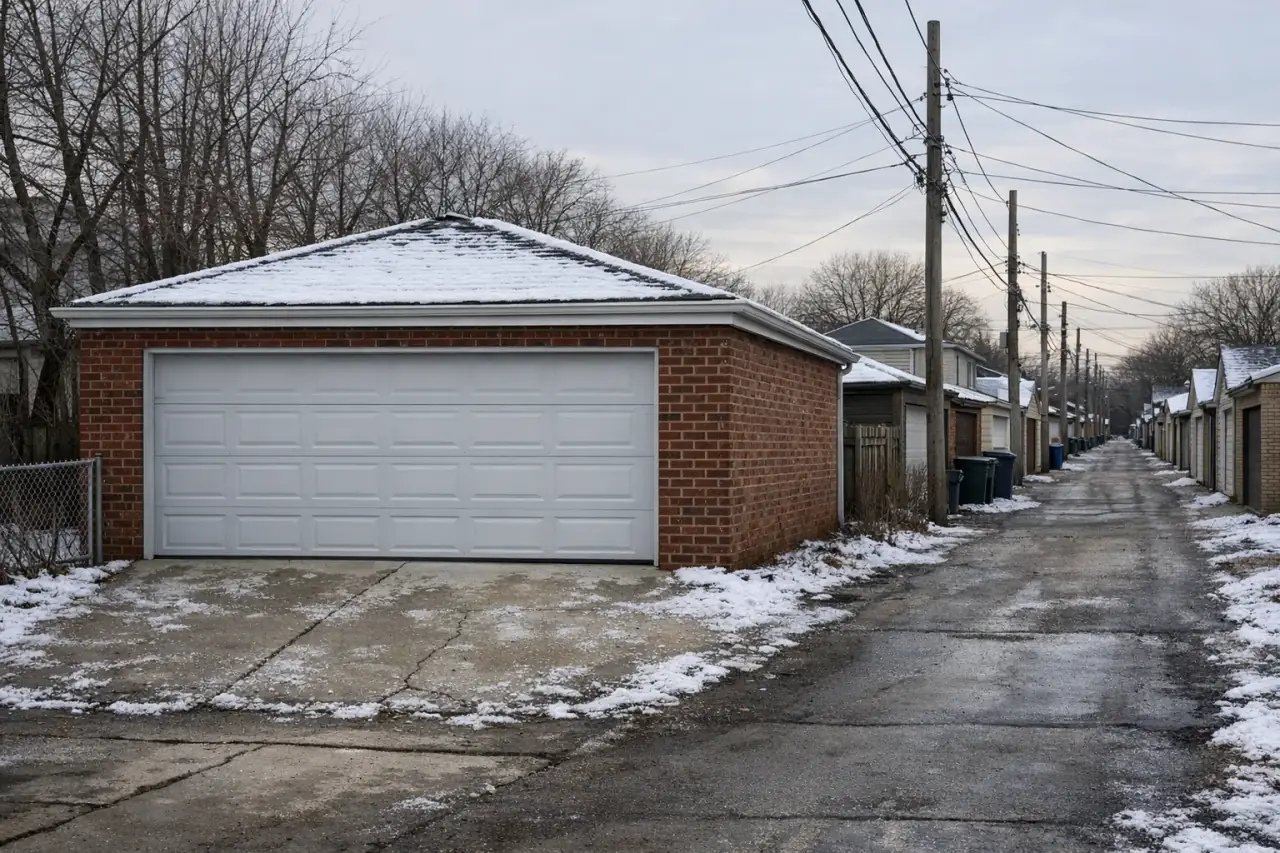
Garages in the city work differently from garages in most of the country. Most Chicago blocks have an alley, and on those blocks the garage usually stands at the back of the lot with its door facing the alley instead of the street. Many of these detached frame and brick garages have stood for decades, and their doors take hits from tight turns, heaving slabs and long winters.
In many suburbs the garage is attached to the house instead, sometimes with living space above it. This guide covers both: what tends to break, what you can safely check, and when to call a professional.
Alley-facing garages and the problems that come with them
An alley garage is easy to forget because you rarely see its door from the house. A door that stops short of the floor, or reverses and stays open, can sit that way all night. An opener with an app or a door-position alert fixes that, though a garage at the back of a long lot may need a Wi-Fi extender.
Narrow alleys also mean tight angles when backing out. Clipped jambs, a bent bottom section and a vertical track knocked out of line are common results. If the door runs crooked after a bump, stop using it, because forcing a misaligned door can pull a cable off its drum.
Keep the side service door locked too. Older fixed-code openers are easier to defeat than newer rolling-code models, which is one more reason to retire a unit that has been on the ceiling for decades.
Frost heave, cracked slabs and gaps under the door
Repeated freezing and thawing works on the concrete under and in front of an older detached garage. Slabs crack, the apron at the alley edge lifts or sinks, and the bottom seal no longer meets the floor at one corner. Snow blows in, and meltwater pools at the threshold and turns to ice.
A taller bulb-style bottom seal can close a small gap, and a threshold strip glued to the floor helps with an uneven one. When a frame garage has started to lean, though, the door will keep binding however the tracks are set, so have a carpenter square up the structure before buying a new door.
Broken springs: the signs and what to leave alone
Springs carry nearly the whole weight of the door, and they wear out with use. You may hear a bang like a firecracker, then find the opener straining to lift the door a few inches before it stops. A visible gap in a coiled spring above the door means it has snapped. A fall tune-up before the first hard freeze is a good time to catch a worn spring before you depend on the door all winter.
Do not try to wind, loosen or replace a spring or a lift cable yourself. Springs store enough energy to cause serious injury when they let go, and the cables and bottom brackets stay under tension even with the door closed. Leave the door where it is, keep kids and pets away, and have a technician replace the spring.
Some garages, especially older detached ones, use extension springs instead, which stretch along the horizontal tracks. If yours have no steel safety cable running through each spring, ask for one or for a conversion to torsion, because pieces of a spring that breaks without a cable can fly across the garage.
Road salt and the bottom of the door
Brine and slush ride in on tires all winter and settle against the lowest section of the door. On steel doors, rust usually shows up first along the bottom edge and at the bracket in each lower corner that anchors the lift cable. A rusted bottom bracket is a safety problem, so have it inspected rather than trying to remove it.
During a midwinter thaw, hose off the bottom panel and the floor in front of it, then dry the seal. Shopping for a new door? Ask about galvanized steel with a baked-on factory finish, or a door with a fiberglass or aluminum skin, which won't rust the way bare steel does.
Summer storms, power outages and opening the door by hand
Chicago summers are hot and humid, and strong thunderstorms can knock out power for hours, leaving a car stuck in a detached garage. Most openers have an emergency release cord hanging from the rail that disconnects the door from the drive so it can be lifted by hand.
Only pull that cord while the door is all the way down. Once it is disconnected, a door that feels far heavier than usual likely has a broken spring, so lower it gently and leave it alone. If outages are common on your block, an opener with a battery backup can keep opening and closing the door for a while without power.
Communities around Chicago with recent service visits
Recent jobs have taken a technician to the communities below. If your town is not listed, ask about coverage when you request a visit.
- Chicago (60608, 60617, 60628, 60643)
- North: Waukegan (60087) and Lake Villa (60046)
- Northwest: Algonquin (60102)
- West: Oak Park (60304), Franklin Park (60131), Addison (60101) and Naperville (60564)
- Southwest: Justice (60458), Palos Hills (60465), Orland Park (60467) and Lockport (60441)
- South: Dolton (60419) and Richton Park (60471)
Last updated by the American Garage Door Team.