
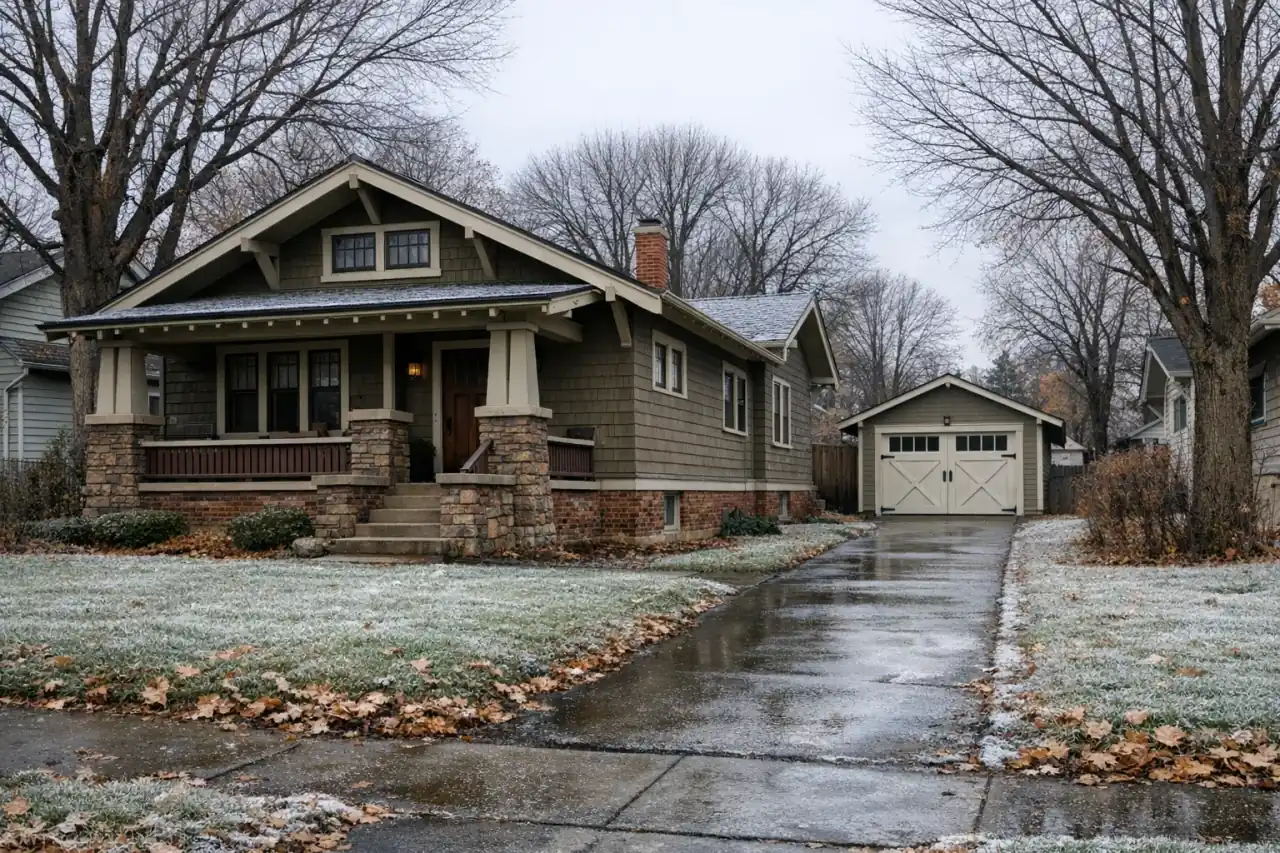
Since Unigov took effect in 1970, Indianapolis has covered nearly all of Marion County. A city address can mean an early-1900s bungalow near downtown or a newer subdivision by the county line, with garage doors ranging from painted wood on small detached garages to wide insulated steel.
The weather ties them together: humid summers, winters that hover near freezing, and an active spring storm season. Here is what that does to doors and openers, and what a homeowner can safely check.
Detached garages in the older neighborhoods
Bungalows caught on in the city shortly after 1900, and many older neighborhoods still have a detached garage set behind the house. Those garages were sized for smaller cars, and some still have a one-piece tilt-up door or a decades-old sectional door.
The door is rarely the only problem. Wood jambs and headers soften, slabs settle, and the opening drifts out of square, so even a new door can bind or leave a gap at one corner. Have the framing checked during the estimate and fix rot before a new door goes up.
Ice, freeze-thaw and the bottom few inches
Winter temperatures here often sit close to freezing, so a storm can bring snow, sleet or freezing rain, and the thermometer swings back and forth. Meltwater that runs under the door during a thaw can refreeze overnight and lock the rubber seal to the concrete.
If the door won't move on a cold morning, unplug the opener first. Running the motor against a frozen seal can tear the rubber, strip gears or bend the top section. Loosen the seal with a plastic scraper or a hair dryer, then sweep out the slush.
Freeze-thaw cycles also move concrete. An apron that heaves in winter and settles in spring can make the door touch down early and reverse, or leave daylight under one side. Salty slush dripping off cars can also rust the bottom corner brackets, which hold the cable ends. Those brackets are under constant tension from the springs, so a rusted one is a technician's job, never something to loosen by hand.
Historic districts and neighborhood rules
Parts of the city, including Irvington and Herron-Morton Place, fall under the Indianapolis Historic Preservation Commission. It requires a Certificate of Appropriateness before most exterior work starts. In Herron-Morton Place, for example, design review can include windows and doors and even paint colors. Work done without a certificate is a violation and can bring late filing fees, delays and costly changes.
Some requests can be approved by staff without a public hearing. Applications generally include photos of the area and product literature, so have the new door's spec sheet ready before you call.
In the suburbs, many subdivisions have homeowners associations with their own rules on colors and styles, so read the guidelines before signing a quote.
Humid summers and storm season
Muggy summers are tough on wood. Wood doors and jambs soak up moisture, swell and rot where paint has worn thin, usually along the bottom edge. Steel copes better, though rust can start at scratches.
Thunderstorms can carry strong wind and hail, and Indiana gets tornadoes as well. Strong wind pushing on a closed door can bow the panels inward, bend the tracks or pop rollers out of them.
Storms also cut power, which is where a battery backup opener helps. To open the door by hand, use the emergency release cord only with the door shut tight against the floor. If it feels very heavy once disconnected, stop lifting, because a spring has probably failed.
A maintenance calendar for central Indiana
A few quick checks timed to the seasons can head off many winter breakdowns.
- Before the first hard freeze: lubricate hinges and rollers, replace a cracked bottom seal and check the safety reverse by closing the door onto a flat board laid across the threshold.
- After the spring thaw: look for heaved concrete, rusty bottom brackets and torn weatherstrip, and wipe the sensor lenses.
- After a severe storm: run the door through a full cycle and watch for rubbing or gaps.
- Midsummer: press on wood doors and jambs to find soft spots.
Jobs completed around the metro area
Past jobs span the city and suburbs in every direction. The list is not a boundary, so ask even if your town is missing.
- Indianapolis (46201, 46208, 46219, 46226, 46231, 46234, 46239, 46240, 46254, 46256, 46280)
- North and northwest: Carmel (46032), Westfield (46074), Noblesville (46060), Zionsville (46077)
- Northeast: Fishers (46037, 46038), McCordsville (46055), Anderson (46011)
- South: Greenwood (46143), Whiteland (46184), Franklin (46131)
- West: Brownsburg (46112), Lizton (46149), Greencastle (46135)
Last updated by the American Garage Door Team.