
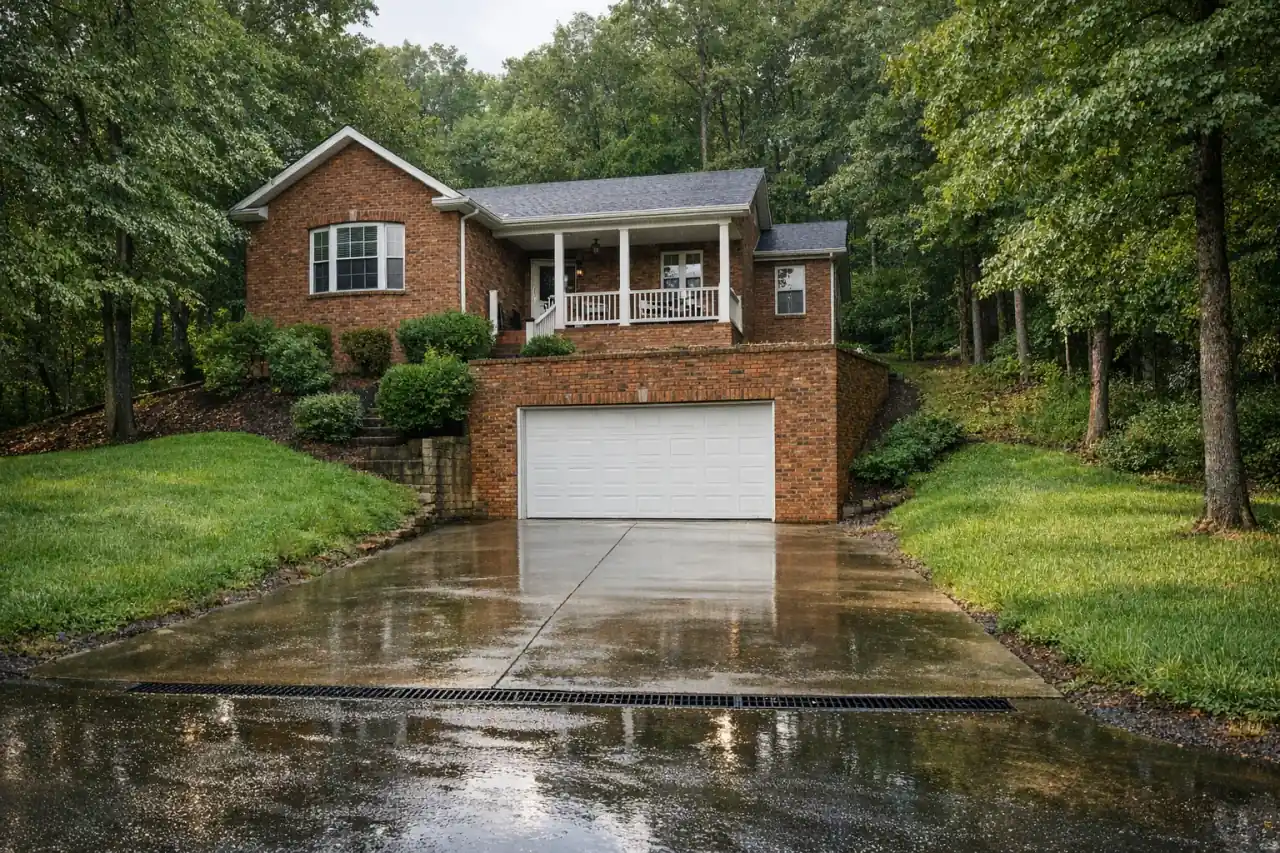
The counties around Nashville have filled with new subdivisions. Williamson County added more residents between 2010 and 2020 than in any earlier decade, and Rutherford County went from roughly 263,000 people to more than 341,000 over those same ten years. A good share of that housing sits on rolling ground, where the garage can end up under the house on the low side of the lot, or turned sideways to the street.
Those layouts shape how a door wears out, and the May 2010 flood and the overnight tornado of March 2020 showed how exposed a garage is to water and wind. Below: what to inspect yourself and what to ask a technician.
Rot behind the jambs of a lower-level garage
When a garage is dug into the slope beneath the living space, its door frame is usually wood fastened against poured concrete or block. Masonry wicks ground moisture, and the wood rots from the back side where nobody sees it. The track brackets, and often the plate that anchors the torsion spring above the opening, depend on that wood holding firm.
Before any new door or spring assembly goes in, ask the technician to probe the jambs and header and replace soft lumber first, ideally with treated or composite trim; fresh hardware on decayed framing only postpones the failure. These under-house garages can also stay muggy from late spring into fall, which may rust spring coils and bottom brackets sooner than in a garage at street level.
- Push a screwdriver tip into the base of each wooden jamb. If it sinks in easily, mention it when you book the visit.
- Run a dehumidifier in summer if the garage connects to a finished lower floor.
Flood openings and what May 2010 taught the region
On May 1 and 2, 2010, the city recorded 13.57 inches of rain, more than double its previous two-day record, according to the National Weather Service. The Harpeth River crested within inches of its record at Franklin, and Mill Creek set a record crest at its Antioch gauge.
In a Zone A floodplain on the federal flood maps, a new or substantially improved garage may have its floor below the base flood elevation only if it meets National Flood Insurance Program rules for an enclosure. FEMA guidance calls for at least two flood openings in its exterior walls, each with its bottom edge no more than one foot above the higher of the inside or outside grade, so water enters and drains unaided. A plain sectional door does not count, since somebody would have to lift it, but engineered vents built into the door's panels can, although FEMA prefers openings in the walls.
Before replacing a vented door, pull out your elevation certificate or call the local floodplain office, then order the new door with matching vents. A solid replacement can quietly remove required openings. If water has already been inside, keep the opener unplugged until its motor, wiring and sensors are inspected.
Checking a door after a storm like March 3, 2020
Shortly after midnight on March 3, 2020, an EF3 tornado crossed John C. Tune Airport, North Nashville and Germantown, then East Nashville, Donelson and Hermitage, before tearing through Mount Juliet in Wilson County. The National Weather Service estimated peak winds of 165 mph. Ordinary spring thunderstorms strain a door the same way, only less violently.
A wide door that bows inward can push its rollers out of the tracks, and once a gap opens, wind rushing into the garage presses up on the roof from inside. After severe weather, look for these signs before touching the wall button:
- Panels creased across the middle, or a horizontal strut pulled away from the door
- Rollers riding outside the track, or a kink where the track curves toward the ceiling
- The opener rail separated from its bracket above the opening
- A slack lift cable or a crooked door: the spring energy is no longer controlled, so stay clear and call
A move-in punch list for Franklin, Thompson's Station and Smyrna new builds
Builder packages often hang a thin, uninsulated steel door on standard-cycle springs and pair it with an entry-priced chain drive. Weak spots appear as the frame settles and daily trips pile up, so walk the garage before the builder's workmanship coverage runs out.
- Lay a 2x4 flat beneath the closing door. It must reverse when it touches the board; if it does not, stop using the opener until it is corrected.
- Check that the photo eyes sit a few inches above the slab and aim squarely at each other.
- Look up at the rear track hangers. They should be fastened into ceiling joists, not just drywall.
- Once a spring snaps, request high-cycle replacements, and have both springs on a two-spring door renewed at the same visit.
Side-load garages and glancing hits
On narrow or steep lots, the garage is often turned so its doors face a side yard. Drivers swing in at an angle, and the door's outer edge and the jamb trim take the scrapes. A bent end stile or creased bottom section can make the door bind even when springs and opener are healthy.
A jamb bumper guard or brighter lighting over the apron often ends the scuffs. Widening the opening means a new header, which usually requires a building permit, so settle that with your city or county before choosing a larger door.
Six counties, from Robertson south to Williamson
A technician can be sent to these communities at any hour:
- Davidson County: Nashville, ZIP codes 37208 and 37209
- Williamson County: Franklin (37064, 37067) and Thompson's Station (37179)
- Rutherford County: Smyrna (37167)
- Wilson County: Mount Juliet (37122)
- Robertson County: Springfield (37172)
- Cheatham County: Pleasant View (37146)
Last updated by the American Garage Door Team.