
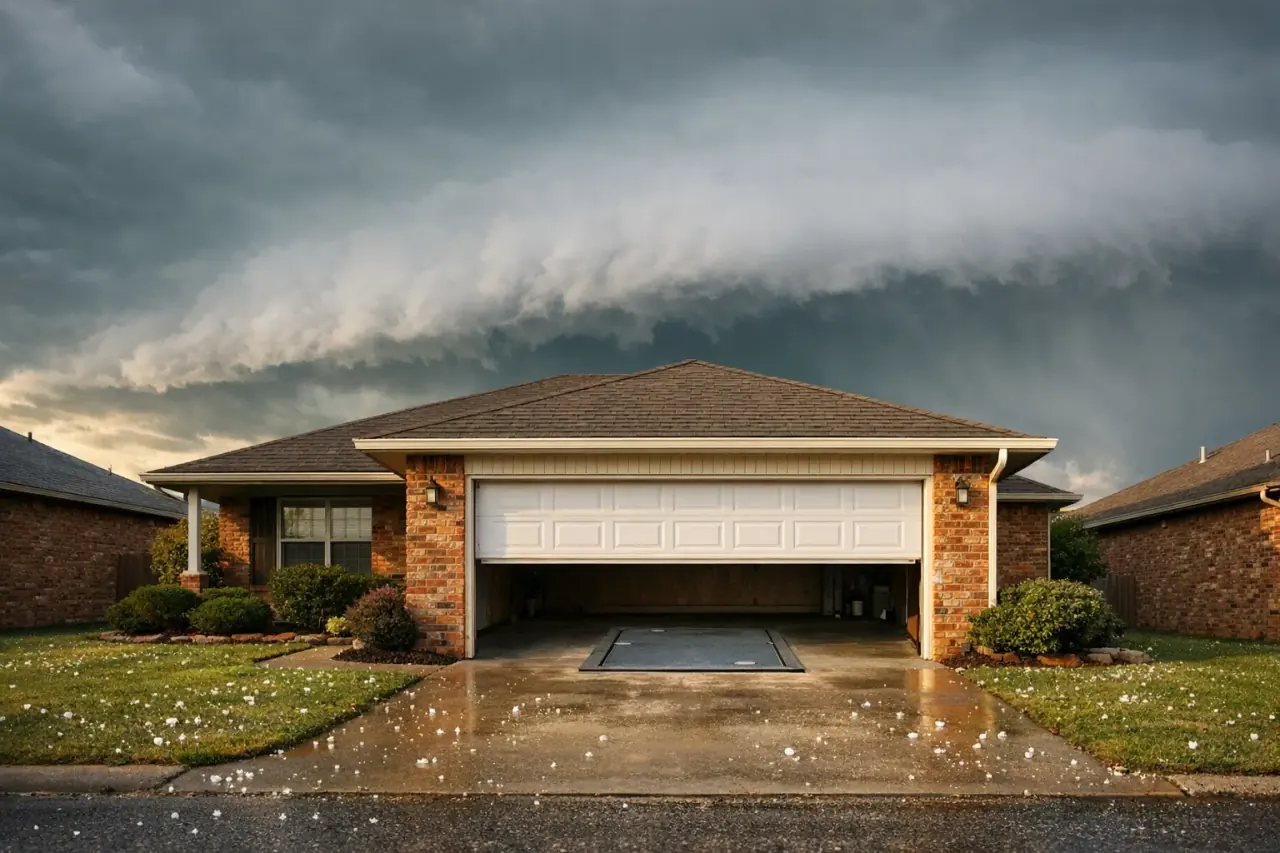
When an Oklahoma City family's tornado plan is a below-ground shelter with a sliding steel lid, cut into the garage slab, the overhead door becomes part of the escape route, on exactly the day its opener is most likely to have no power.
The same door also takes spring hail, gusts from storm lines that never produce a funnel, and the occasional ice storm. Below is what each one does to it, and what belongs in a quote.
A car parked over the shelter lid blocks your exit
A slab shelter usually takes up part of a parking bay, so plenty of families park right on the lid. During a warning there may be only minutes to get underground, and backing an SUV out with the big door open to the storm is the wrong use of them.
Treat a tornado watch from the Storm Prediction Center in Norman, which means tornadoes are possible over the next few hours, as the cue to move whichever car covers the lid, even onto the driveway on a hail day. A dented hood beats a hatch you can't open. Some families swap bays for good so the lid sits under open floor.
- Sweep the lid's slide path clear of gravel, toys and storage bins.
- Lower the overhead door fully, and keep the opener's backup battery charged if it has one.
Coming up to a powerless opener and a closed door
Expect no electricity when you lift the hatch: the wall button, remote and keypad are all dead. Every adult should know how to disconnect the door from the opener and raise it by hand, and should have practiced once with the door closed.
Look before pulling anything. A door bowed inward, off a track or pinned by a limb still has loaded springs overhead and can drop or twist. Leave it, use the side door or the house door, and if debris has you boxed in, stay put and call for help.
Ask a technician to confirm that one adult can lift the door, that the release handle hangs within reach of the shortest family member, and that the backup battery still holds a charge after a hot summer.
OKC proper, Norman, Edmond or Piedmont: whose shelter list are you on?
A mailing address that reads Oklahoma City doesn't prove the house is inside city limits, and the city's online shelter registry takes only shelters within them. Norman keeps its own registry, with garage listed as a shelter location; in Edmond or Piedmont, ask the city or county. If you bought a house with a shelter already in the floor, put the registration in your name.
We can send a technician for repairs, openers and new doors here:
- Oklahoma City: 73135, 73142, 73160 and 73165
- Edmond, to the north: 73003, 73013 and 73034, plus 73012, a code that once belonged to the small town of Bray
- Piedmont, northwest of the city: 73078
- Norman, down I-35 to the south: 73069, 73071 and 73072
Separating cosmetic hail dimples from a section that is failing
Spring hail can pock a steel door like a golf ball in minutes, yet dimples alone seldom stop it from working. The real question is whether the steel folded. From inside and out, look for a crease across a section near a hinge line, a kinked strut or cracked glass in a window insert, then watch a full cycle for flexing or a hitch at the same spot.
For the claim, photograph the whole door and each damaged section before repairs, and ask the adjuster to list the door apart from the roof. Ask whether sections in your model and color are still made, because a mismatched panel stands out. On a replacement, a lower gauge number means thicker steel, and foam layered between two steel skins resists dents better than a single sheet.
Straight-line gusts, bowed doors and what a wind-load rating buys
Storm lines without a tornado can still lean hard on a sixteen-foot door, bowing it inward, popping rollers out of the track or prying a track off the jamb. Don't run the opener or pull the release on a door like that; once freed, it can slam down. A technician should reseat the track, check hinges and struts for cracks, and inspect the springs and cables jolted by the hit.
No door is tornado-proof, but a wind-load-rated one, with heavier struts, stouter track and a label stating its pressure rating, is built to stay put through the gusts behind much ordinary storm damage. In 2014, a year after its deadly tornado, neighboring Moore began requiring garage doors on new houses to be rated for 135 mph winds, a fair benchmark anywhere in the metro.
Ask how the jambs will be anchored, whether rotted framing must go first, and whether the rating holds with your chosen windows. Skip removable hurricane-coast storm braces; they suit days of warning, not a siren, and block the way from shelter to driveway.
Ice storm outages: frozen seals, an unlocked door and the generator rule
In late October 2020 an early-season ice storm glazed central Oklahoma. At least an inch and a half of freezing rain was reported in places, big limbs and trees came down from Piedmont to Norman, and hundreds of thousands of people lost power.
Ice glues the bottom seal to the driveway, and running the opener against it can rip the rubber or strip a gear. Once you pull the release, the opener no longer holds the door shut, so slide the manual lock over if there is one, or reconnect the trolley when power returns.
Never run a generator in the garage, even with the overhead door wide open; an open door won't stop carbon monoxide from building up. Keep it outside, well away from windows, doors and vents.
Last updated by the American Garage Door Team.