
What exactly is your door doing?
"Won't close" covers several different behaviors, and each points somewhere specific. Watch one full attempt and match it here before you start adjusting anything.
| What you see | Most likely cause |
|---|---|
| Door starts down, then reverses before reaching the floor | Photo-eye problem, force too sensitive, or binding |
| Door touches the floor, then goes back up | Close limit set too far |
| Door won't move down at all; opener light flashes | Sensor fault (blocked, misaligned or wiring) |
| Door closes only while you hold the wall button | Sensor fault; the opener is in override mode |
| Remote won't close it, wall button will | Lock mode, remote battery or programming |
| Door stops partway and sits crooked | Track, roller or cable problem |
| Door hangs unevenly or sags after a loud bang | Broken spring or cable; see safety note below |
Safety: If a spring has snapped while the door is up (you heard a bang, or you can see a gap in the spring above the door), do not pull the emergency release. The opener's trolley is now holding weight the spring used to carry, and releasing it can let the door drop hard. Keep people and pets out from under it and call for emergency repair.
What are the 8 most common reasons a garage door won't close?
1. Something is blocking the photo-eyes
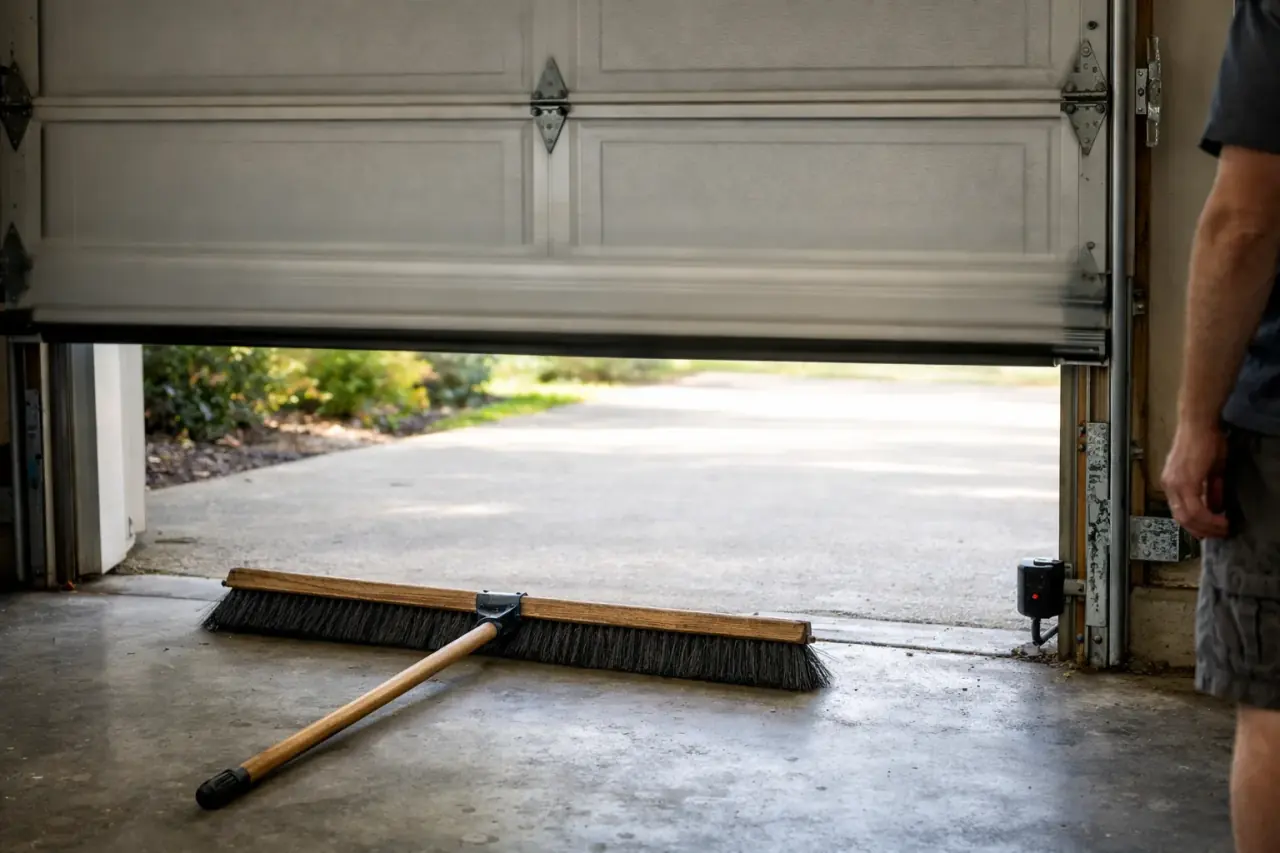
The two small sensors near the bottom of the tracks project an invisible beam across the opening. Anything that breaks it, even a broom handle, a recycling bin lid or a spider web across a lens, will stop the door from closing. Clear the area and wipe both lenses with a soft cloth.
2. The photo-eyes are misaligned or sun-blinded
One sensor sends the beam and one receives it. Each has a small indicator light: on many brands, the sending side glows steadily and the receiving side glows steadily only when it sees the beam. A light that flickers or is out means alignment is off, often because a bumper, bike or kid nudged the bracket. Loosen the bracket nut, pivot the receiver until its light is solid, and retighten.
If the problem only shows up at a certain time on sunny days, direct sunlight is overpowering the beam. Swapping the sending and receiving units side to side usually solves it; a small hood over the receiver also works. Brand-by-brand details are in what each sensor light means.
3. The sensor wiring is damaged
Thin low-voltage wire runs from each sensor up to the motor unit. A staple driven through it, a chewed section or a loose terminal at the opener creates a fault that looks like misalignment. Trace the wire end to end. If both indicator lights are dark, power isn't reaching them and the wire or the opener's sensor terminals are the problem.
4. The close limit is set wrong
The close limit tells the opener where the floor is. Set too far, the door hits the floor before the opener expects it, reads that as an obstruction, and reverses. Set too short, the door stops a few inches up.
Older openers use a limit screw on the motor unit; newer ones use buttons and a learning procedure in the manual. Adjust in small steps, then prove it with the board test: a 2x4 lying flat in the opening must send the door back up on contact.
5. The door is binding, or the force setting is off
Openers are built to back off when the door fights them partway down. Dry or broken rollers, a bent track section, a worn hinge, or a door that has lost spring balance all add resistance. Look and listen along the full travel.
Fix the binding before you touch force settings, and never crank up force to push past it. A force setting that's too high is how doors injure people. If the door has jumped its rollers, read what to do when a garage door is off track.
6. The remote is the problem, not the door
If the wall button closes the door but the remote doesn't, the door is fine. See whether someone switched on the wall console's lock feature, put a fresh battery in the remote, or reprogram it. The pairing steps are in our remote programming article.
7. Something is in the track or under the door
A wedged roller, a tool on a track bracket, or ice frozen to the bottom seal in winter can all stop a door. In cold climates, thickened lubricant and a stiff bottom seal can make the door reverse at the very end of its travel. Clear the path, chip ice away gently (never pry the bottom panel), and test again.
8. Broken spring or slipped cable
A broken spring or a cable that has slipped off its drum leaves the door unbalanced, crooked or impossibly heavy. The opener may refuse to move it or reverse right away. This is never a DIY repair: springs and cables are under tension that can cause severe injury. Frayed or slipping cables show up in a few telltale ways; for a snapped spring, call for spring replacement.
How do you close a garage door that won't close tonight?
Work down this list and stop at the first one that works:
- Keep constant pressure on the wall control. Most openers will close against a sensor fault as long as you hold the wall button down for the entire trip. Stay at the button and release it if anything gets in the way.
- Try the wall button if the remote fails. If the remote alone is the problem, the wall control usually still closes the door.
- Close it by hand only if it's balanced. If the springs and cables look intact and the door isn't crooked, pull the emergency release, lower the door slowly using the inside handle or a flat panel face (keep fingers away from the joints between sections), and engage the slide lock if it has one.
- If a spring or cable is broken, leave it. Don't release the opener. Block the opening as well as you can, keep everyone clear and call a technician. Our emergency checklist has tips for securing a garage that won't shut.
Once the door is down, unplug the opener if you suspect wiring damage, so it can't reopen on its own.
What should you avoid when troubleshooting?
- Taping over or removing the photo-eyes, or jumping their wires to defeat them
- Raising the close force to push through resistance
- Pulling the emergency release while the door is open and unbalanced
- Prying on the bottom panel to free a frozen door
- Loosening anything attached to the springs, cables or bottom brackets
When is it time for a technician?
Bring one in when the sensors are clean, aligned and wired correctly but the door still reverses, when the door sits crooked or one cable hangs loose, when a spring is visibly broken, or when your home can't be secured. We repair sensors, limit systems and logic boards, and a door stuck open after dark is exactly what our round-the-clock emergency service is for. Estimates are free; reach us here or review our services.
If your problem is the opposite, a door that won't go up, follow our step-by-step guide for a garage door that won't open.
Key takeaways
- Most doors that won't close have a sensor problem: blocked, dirty, misaligned or sun-blinded.
- A door that touches the floor and bounces back needs a close-limit adjustment.
- Holding the wall button is the standard temporary override, as long as you watch the door.
- Never defeat the sensors or raise force to get a door down.
- An open door with a broken spring stays put until a pro arrives.