
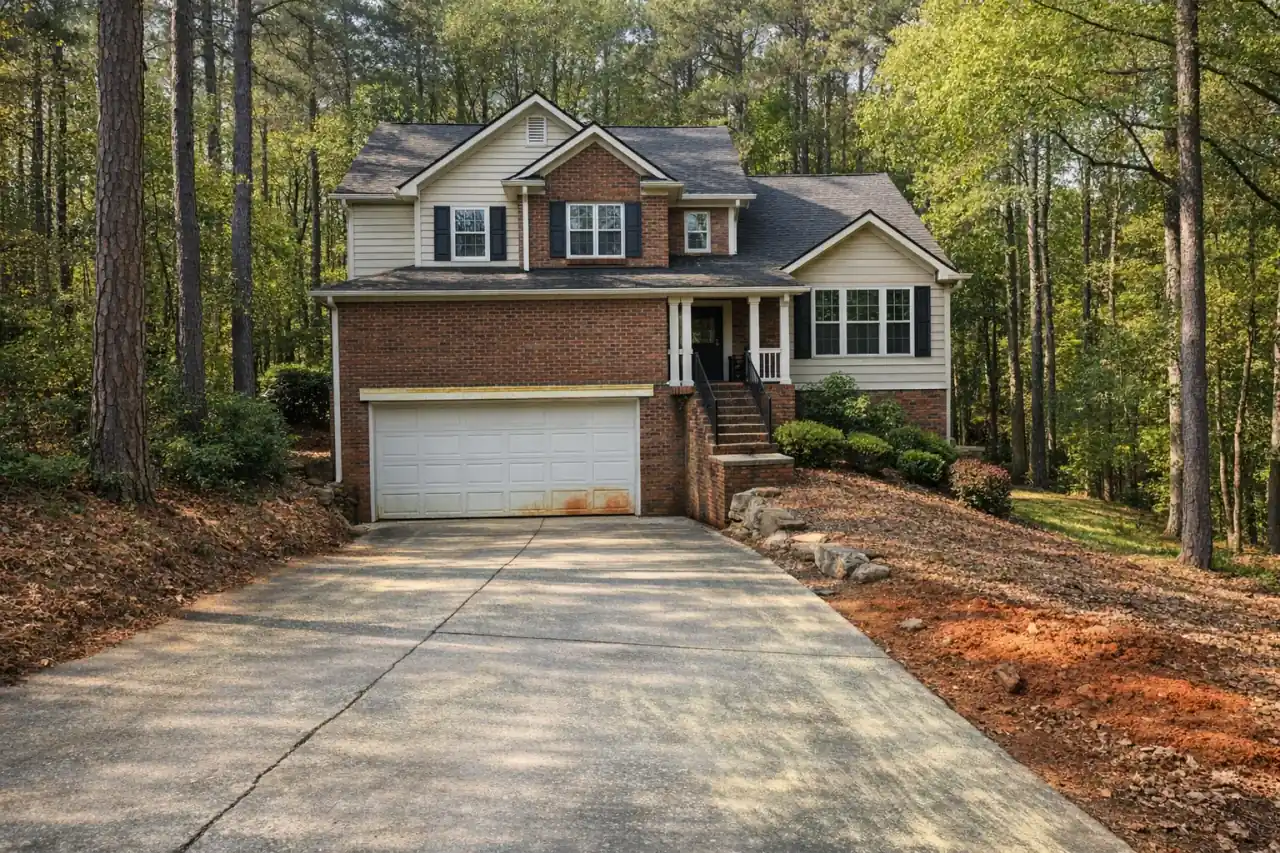
Atlanta sits in the foothills of the Appalachians, at the highest elevation of any major city east of the Mississippi River. Neighborhoods roll over ridges and dip into creek hollows, so many houses tuck the garage beneath the living space, at the foot of a driveway that falls away from the street. That design choice sits behind several of the door problems covered below.
Atlanta is often called the City in a Forest. The pines in that canopy lay down a yellow coat of pollen every spring, and the broader tree cover means ice-heavy limbs on the occasional nights when freezing rain arrives. Red Piedmont subsoil and suburbs governed by homeowners associations round out what follows.
Tuck-under garages and slabs that aren't level
A garage cut into a hillside rarely gets a dead-flat slab. Builders often pitch the floor toward the opening so water runs out, and years of settling can add a side-to-side tilt. The door then touches down on one corner first and leaves a wedge of daylight at the other.
Openers read that early contact as an obstruction, so the door bumps the high corner and heads back up. Resist turning up the close-force dial: it belongs to the safety-reversal system, and a door told to push harder pushes harder on a child, a pet or a car hood.
A slight tilt can usually be absorbed by a taller, softer bottom seal. A bigger one may call for resetting the travel limits, making sure the tracks hang plumb rather than following the slope, or concrete work. Before the visit, close the door and note where light shows at each end.
Red Piedmont clay on the lowest panel
Below the topsoil across much of the Piedmont lies red, kaolinite-rich clay that owes its color to iron oxide. Hard rain splashes it onto the lowest panel, and a garage set below grade catches more of it. Left to bake, the orange film settles into the embossed wood-grain texture of a steel door.
Wash it off soon after a storm with a hose, a soft brush and car-wash soap. Skip scouring pads and harsh solvents, which can cut through factory paint, and spot-test any rust-stain remover in a hidden corner. When it's time for a new door, a tan or brown finish disguises splash far better than white.
Dried clay also wears parts. It turns into a fine grit that packs into the retainer channel holding the bottom seal and into the bottom end of each vertical track, where rollers grind it against the steel. Wipe both with a damp rag every few months, and never grease the tracks, since grease turns that dust into paste.
Pine pollen versus the safety sensors
Pine produces the yellow pollen you can actually see, even though oak is the bigger allergy culprit. Each spring it settles on everything in an open garage, including the two small photo eyes mounted low beside the tracks.
A dusty lens weakens the invisible beam between those sensors until the opener refuses to close, reverses for no clear reason or, on many models, blinks its light. Wipe both lenses with a soft dry cloth, then check that each indicator light glows steadily instead of flickering.
Pollen also clings to fresh lubricant, turning it into a gummy paste on hinges and roller stems. Wait until the yellow film stops coming back, wipe off the old residue, then apply a garage door spray.
Freezing rain, falling limbs and a dead opener
Ice storms usually cause more problems around Atlanta than snowfall does; the most severe struck on January 7, 1973. Ice-loaded branches pull down power lines, and a family whose everyday entrance is the garage under the house can end up behind a door that won't budge. When the National Weather Service office in Peachtree City mentions freezing rain, review these steps:
- Locate the red emergency release cord on the opener trolley. Pull it only once the door is all the way down, because an open door with a snapped or slack spring can fall the instant it is freed.
- Raised by hand, a well-balanced door takes moderate effort and holds its position partway open. One that won't hold or seems far too heavy has a spring problem, so stop lifting, leave it shut and call a professional.
- Once the lights are back, re-engage the opener by following its manual; many units hook back onto the trolley on their next run.
- If a limb strikes the door, don't cycle it to see what happens. A buckled section can bind in the tracks and load the cables suddenly, so leave it shut and ask for an inspection.
Getting a new door past the architectural committee
In many subdivisions around Alpharetta, Suwanee and Marietta, the covenants give an architectural review committee a say over exterior changes visible from the street, and a garage door usually counts. Many doors are ordered to size and style, so get the committee's sign-off before anything is purchased. Questions to put to the HOA or management company early:
- Does a like-for-like swap, same style and color, still need an application?
- Is there an approved color list, and must the door match the trim or shutters?
- Are glass top sections, decorative handles or strap hinges allowed on a street-facing door?
Outside the Perimeter: towns on the service list
Calls come from suburbs outside I-285, the highway locals call the Perimeter. Here is the current list, grouped by direction from downtown, with ZIP codes; if your town is missing, just ask. Canton, up in Cherokee County, has its own page.
- West: Douglasville (30134) and Villa Rica (30180)
- Northwest: Dallas (30132, 30157) and Marietta (30062)
- North: Alpharetta (30022)
- Northeast: Norcross (30092) and Suwanee (30024)
- East: Lithonia (30058)
- Southwest: Palmetto (30268)
Last updated by the American Garage Door Team.