
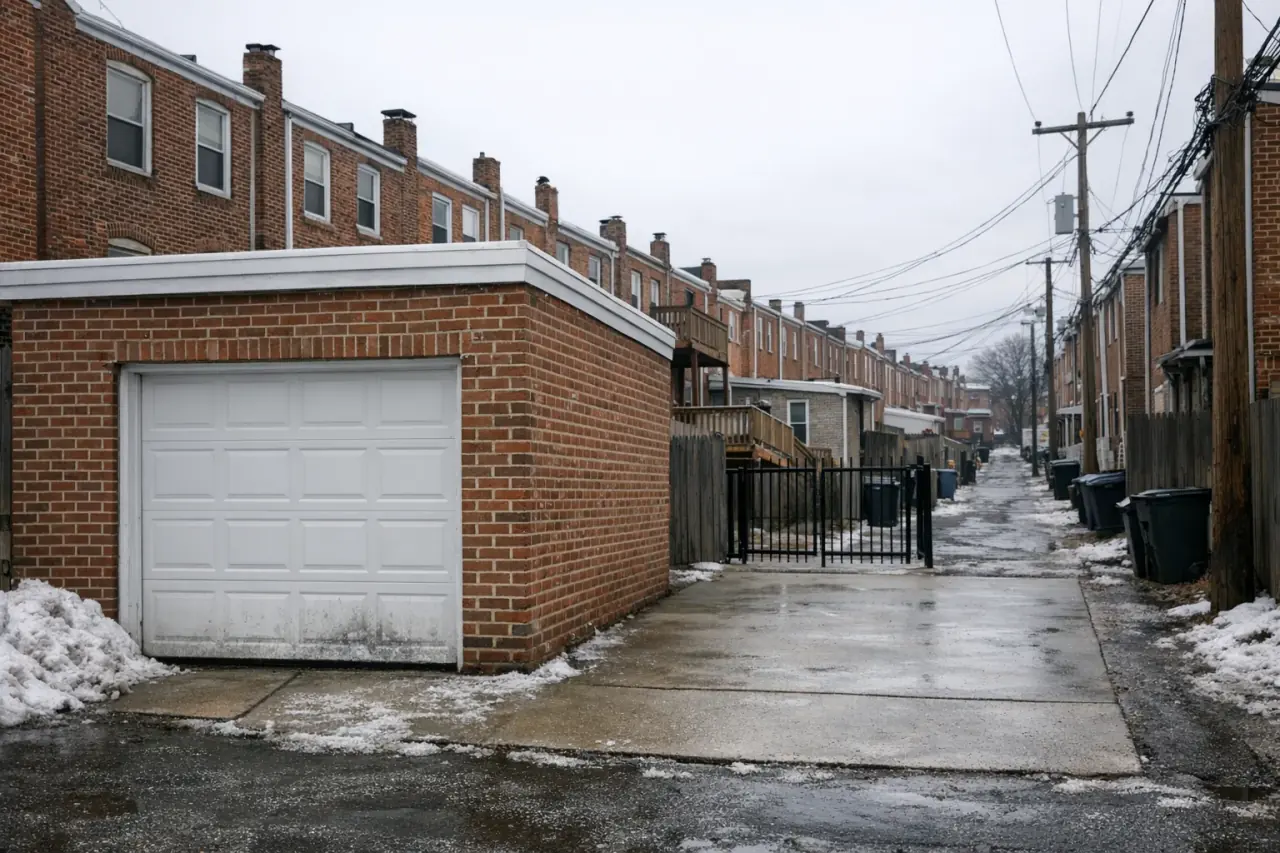
Baltimore splits garage ownership into two worlds. Inside the city, a rowhouse fronts the street, and any off-street parking is usually out back, on a concrete pad or in a detached garage that opens onto a shared alley. Past the city line, in places like Columbia, Abingdon and Severna Park, the garage is often attached, and its rules come from a county office, a homeowners association or a village covenant.
Winter ties both worlds together with coastal storms, sleet and road brine, so the weather comes last below, after the alley and the paperwork.
The garage out back: alley access, pads and gates
A rowhouse garage usually sits at the back of a narrow yard, its door opening onto an alley the whole block shares. When you request a visit, say which street the alley opens from and where a van can stop without boxing in a neighbor's pad.
Under the city's Gating and Greening Alleys law, the owners along an alley can petition the city's transportation director to gate it, or to gate it and green it with plantings. Gating alone needs signed consent from at least three-quarters of the abutting owners, greening needs all of them, and the police and fire departments review every petition before a public hearing. If your car uses that alley, raise access early, while signatures are still being gathered.
Many older detached garages behind rowhouses were built for smaller cars. Openings run narrow, headers sit low, and the wall beside the door can be too tight for standard track and springs, so a replacement may have to be ordered to measure. Get the opening size, headroom and side clearance in writing before comparing quotes.
- Unlock the alley gate before the visit, or plan to meet the technician there.
- Mention whether the garage has a sectional roll-up, a pair of swing-out doors or an old one-piece tilt door.
- Leave a broken door where it stopped. Do not prop it, pry at the springs or cut a cable to free the car.
CHAP review on the alley side of a historic rowhouse
The city's Commission for Historical and Architectural Preservation, known as CHAP, has designated 38 neighborhoods as local historic districts and more than 200 landmarks. Exterior changes there generally need an Authorization to Proceed, and a building permit application filed first sits on hold until that review is done. The executive director can approve minor work, while major alterations go to a public hearing.
CHAP's design guidelines note that alleys in many historic neighborhoods once served carriage houses and sheds, and they ask owners to preserve and maintain surviving historic garage and carriage-house doors. Where a historic door is missing or beyond repair, the replacement should suit the building's type and era, and new garage openings belong on rear elevations whenever possible.
So get the paperwork moving before anything is ordered. Photograph the existing door from the alley, and send CHAP staff a drawing or brochure page showing the new door's panel pattern, material and color.
Columbia village covenants and the garage door order
Columbia, the Howard County planned community unveiled in 1967, is made up of ten villages. Each has covenants that run with the land and an architectural committee that applies them, and in Hickory Ridge a covenant advisor at the village office helps residents prepare applications.
Hickory Ridge's 2022 guidelines show how this works for garage doors. No application is needed for a traditional raised-panel or flush door with no windows or only plain standard ones, colored to match the siding or trim, and matching any other garage door on the house. Anything else needs a color photo or brochure, a description of materials, dimensions, color and style, and a paint or stain sample if one applies.
That village asks for at least four weeks of processing time, and its approval does not replace Howard County permits or any separate approval a townhouse association requires. When a wrecked door must be replaced quickly, a plain door that meets the no-application terms is the fast route; order a carriage-house design with decorative glass only after written approval.
City line or county line: where each address answers
Baltimore City is an independent city, separate from Baltimore County, yet many county homes use a city mailing address. Permits and inspections follow the jurisdiction where the parcel sits, not the town on your mail, and newer subdivisions often add a homeowners association with door rules of its own. Recent calls have reached the communities below; Annapolis has its own page.
- Howard County: Columbia (21044, 21045) and Ellicott City (21042)
- Baltimore County: Catonsville (21228) and Owings Mills (21117)
- Carroll and Frederick counties: Sykesville (21784) and Monrovia (21770)
- Harford County: Abingdon (21009)
- Anne Arundel County: Severna Park (21146) and Odenton (21113)
- Prince George's and Montgomery counties: Bowie (20720), Upper Marlboro (20774) and Chevy Chase (20815)
Piedmont snow, coastal storms and brine on every tire
The rolling Piedmont north and west of the city, around Owings Mills, Sykesville and Monrovia, generally gets more snow than the coastal plain toward Odenton and Severna Park, and the January 2016 blizzard set an all-time snowfall record for Baltimore, measured at BWI Airport. After a big storm, clear the bottom section and the floor under each track before pressing the button, since an opener straining against packed snow can bend the top section or strip its drive gear.
Nor'easters bring hours of wind out of the northeast with rain, sleet or wet snow. A garage facing that way takes the spray head-on, so check the seal along the top and sides each fall, and wipe ice off the photo-eye lenses after a glaze, because an iced lens can send the door back up every time.
Ahead of storms, the State Highway Administration sprays state highways with salt brine, and the residue rides into garages on tires, drying into a white crust on the lowest panel, the bottom brackets where the lift cables attach and the base of each track. Rinse those spots with plain water once roads dry, and have a technician look at any bottom bracket with flaking rust. It carries the pull of the springs through the cable, so never loosen or remove one yourself.
Last updated by the American Garage Door Team.