
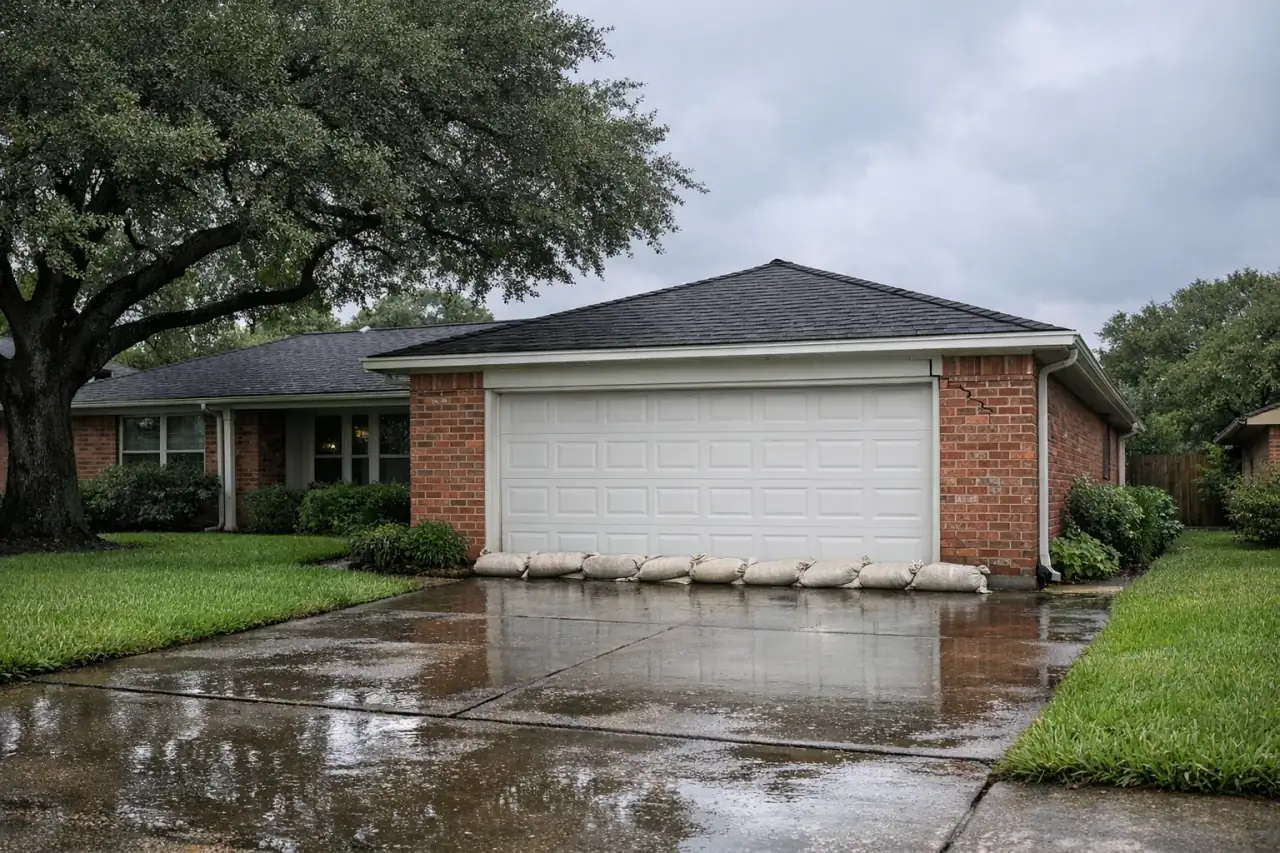
Storms, soil and steam-bath summers wear on a Houston garage door faster than age does. Gulf storms push water up driveways and cut the power for days, the clay under many slabs swells and shrinks with the seasons, and an average year brings more than a hundred days at or above 90°F, with muggy air to match. Each one breaks something different.
Getting the car out when the lights stay off for days
Hurricane Beryl came ashore near Matagorda on July 8, 2024, as a Category 1 storm, and Houston took a direct hit from its eyewall. About 2.2 million CenterPoint customers lost power, and two days later more than a million homes and businesses were still dark in July heat.
Practice the emergency release before you need it. Pull the cord, usually red-handled, only while the door is fully down, because releasing an open door with a failed spring can let it crash. A sound door then lifts by hand and holds its place near mid-height; one that won't budge or sinks back has lost spring support, so leave it down and call a technician.
- Slide the inside lock after lowering the door by hand, because a released door is no longer held shut.
- Once the grid is back, re-latch the trolley as the opener manual explains; on many models one full powered cycle does it.
Battery backup and the surge when power returns
Openers with built-in battery backup can cycle the door a limited number of times without grid power, often enough for an evacuation or a supply run. Garage heat shortens battery life, so the one that came with the house may be spent; a technician can load-test it on any visit.
Power that returns in spikes and flickers can fry an opener's circuit board, so plug it into a surge protector or unplug it until the lights settle. Shopping for a new opener? Ask whether the battery is built in, whether the motor suits a heavy insulated double door, and whether the keypad works on battery power.
After high water: checks before the door runs again
Harvey stalled just inland from the Texas coast in late August 2017, and its floods inundated hundreds of thousands of homes, and lesser storms since have still sent water into garages on low, flat streets that drain slowly.
Floodwater attacks the bottom of the door first. Photo eyes and their thin wires sit a few inches off the floor, the seal retainer and lowest panel start to corrode, wood swells along the bottom rail, and foam-filled steel can trap moisture behind its inner skin.
Have an electrician clear any outlet the water reached before the opener runs. Photograph the waterline for the insurance claim and hose silt from the tracks, but leave bottom brackets and cables to a technician, since they carry full spring tension. Mention how high the water rose and whether the opener has run since.
When the clay under the slab pulls the opening out of square
Large stretches of coastal prairie between the Colorado and Trinity rivers sit on Lake Charles clay, a smectitic soil that USDA describes as cracking open when dry and closing again one or more times a year. The slab rises and sinks unevenly with it, and a wide garage opening under a heavy header often shows the movement first.
Watch for symptoms that come and go: daylight under one corner of the seal, a lock bar that misses its slot, or stair-step cracks in brick climbing from a header corner. Measure the opening corner to corner both ways and note the date. If the diagonals differ noticeably, the frame is out of square, and a repeat measurement next season shows whether it is still moving.
- Have the tracks re-plumbed and re-spaced to the jambs, not bent to fit.
- Close a tapered gap with a taller bottom seal or a floor threshold.
- Re-aim photo eyes that drift as the frame shifts.
- Never turn up the opener's force setting to stop reversing; that disables the protection against crushing a person or pet.
No zoning, but plenty of rules about what faces the street
Houston has no formal zoning, so recorded deed restrictions do much of that job. The City can sue for an injunction to enforce certain ones under Chapter 212 of the Texas Local Government Code, including setbacks from lot and street lines, the size and type of structures, and which way a structure faces.
A straight door swap is the least likely to raise questions. Converting the garage, widening a single opening to a double, or adding a carport near the building line can collide with a restriction, and master-planned subdivisions may want an architectural review committee to approve style and color first.
Friendswood straddles the Galveston and Harris county line. The Galveston County side lies in the coastal catastrophe area, where a Texas Windstorm Insurance Association policy generally requires a certificate of compliance for repairs and alterations, so ask whether a door replacement needs a windstorm inspection before the old door comes down.
- Does a like-for-like replacement need an application?
- Are window inserts, carriage-house hardware or darker colors allowed?
- Can an emergency replacement go in before approval?
North to Porter, east to Baytown, south to Friendswood
Requests have come in from well beyond the city limits, grouped here by direction:
- Houston addresses: 77025, 77068 and 77084
- North: Spring (77380) and Porter (77365)
- Northwest: Cypress (77433)
- East: Baytown (77521) and Crosby (77532)
- South: Friendswood (77546)
Last updated by the American Garage Door Team.