
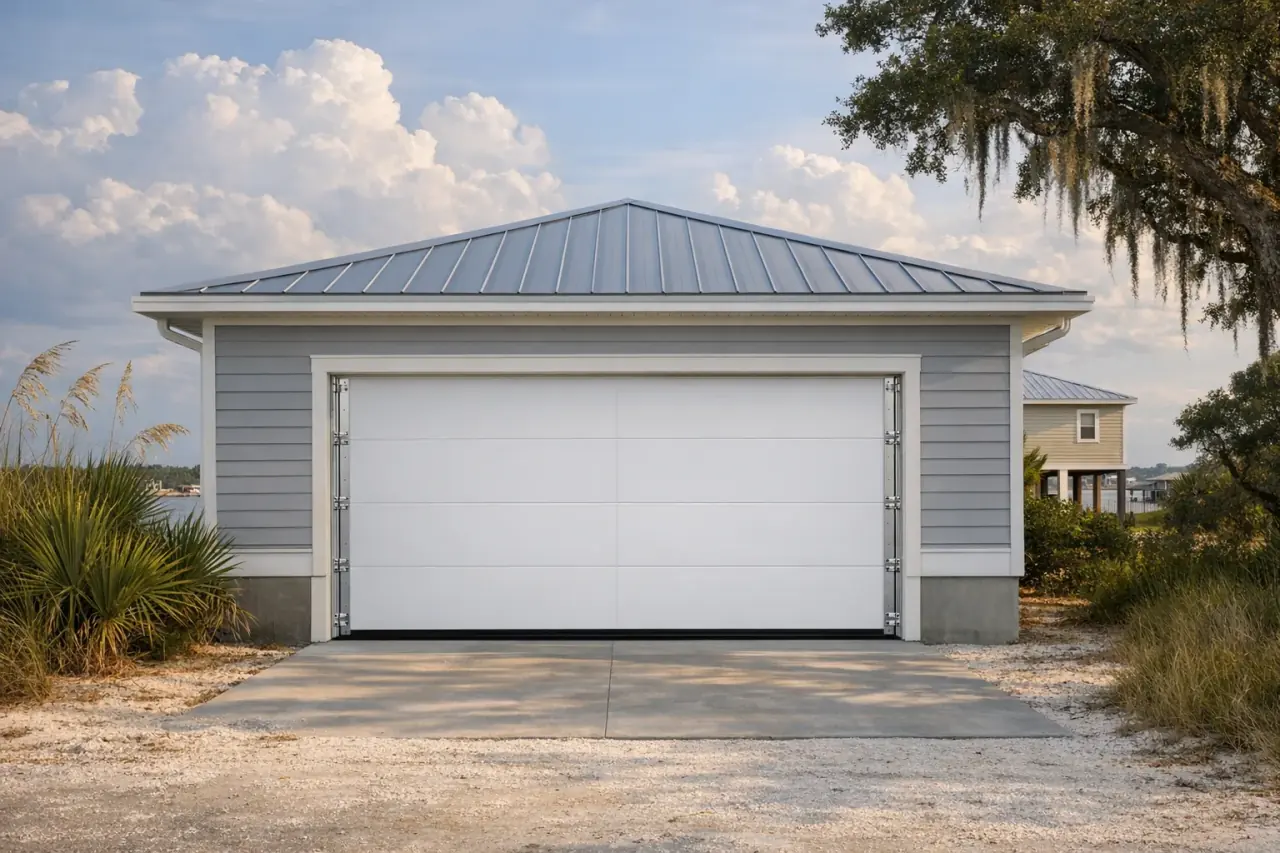
Ivan and Sally both came ashore near Gulf Shores, Alabama, on September 16, sixteen years apart: Ivan in 2004 with wind and surge, Sally in 2020 with two days of rain. Add Gulf salt, sixty-eight inches of rain a year and households that move on military orders, and garage doors here carry a heavier load than most.
Two storms on September 16, two kinds of garage damage
Ivan arrived at 1:50 in the morning as a Category 3 storm, pushed ten feet of surge into Pensacola, knocked a quarter mile of the Interstate 10 bridge into Escambia Bay and gusted to 107 mph at the naval air station. Sally, a slow Category 2, dropped 24.88 inches of rain just west of the base, raised the bay gauge to its third-highest level on record and lost a section of the Three Mile Bridge to a loose construction barge.
So check both ends after a storm. Look up for a door pushed out of its tracks or bowed at the center, and look down for waterlines on the bottom panel and rust at the corner fittings. A slack cable or a door stuck partway means hands off: unplug the opener and call for a technician, because the springs hold those parts under heavy tension.
From a one-mile carve-out to wind lines along I-10 and Canoe Creek
When Florida's first statewide code took effect, a 2000 law limited the Panhandle's wind-borne debris rules, from Franklin County to the Alabama line, to land within one mile of the coast. After Ivan the Legislature ordered a review, the Building Commission voted in February 2006 to scrap the carve-out, and new lines took effect that December. Escambia County now draws them along landmarks: 140 mph at Canoe Creek in the north, 150 mph along Interstate 10, 160 mph at the Gulf shoreline. Santa Rosa County uses Highway 4, a line from East Bay along Avalon Boulevard and US 98, and the beach for the same three speeds. Because debris rules begin at 140, nearly every house in both counties needs impact glass or approved protection on any window in a garage door.
The permit depends on the parcel. Inside the city, the Development Services Department's Building Inspections Division takes applications through the MGO Connect portal. Warrington, Ferry Pass, Brent, Ensley, Bellview, Myrtle Grove, West Pensacola and Perdido Key answer to Escambia County Building Services, whose published list says plainly that replacing any exterior door, garage doors included, requires a permit, and which staffs a Pensacola Beach office two days a week. Navarre and Pace go to Santa Rosa County's permitting office in Milton; Gulf Breeze and Milton are cities of their own. Our permit article explains the application, and the debris-region rules are covered in our ratings explainer.
PCS season and the garage door nobody tests
Naval Air Station Pensacola trains aviators and hosts the Blue Angels; Whiting Field near Milton flies most of the Navy's primary flight training and every one of its helicopter students; and Hurlburt Field sits 35 miles east. Families come and go on military timelines, often in summer, and the garage door gets used constantly and checked never.
- Arriving: close the door on a flat board laid across the threshold; it should reverse on contact.
- Arriving: with the door closed, pull the emergency release and lift by hand. A balanced door stays put halfway; if it drops or shoots up, call a technician.
- Arriving: clear the opener's memory and change the keypad code, since earlier occupants may still hold working remotes.
- Leaving: keep boxes and storage pods clear of the door's path and the safety sensors, and give a property manager the opener details.
Stainless within 3,000 feet of salt water
FEMA's recovery advisories after Ivan told the region to use stainless steel or hot-dip galvanized fasteners within 3,000 feet of salt water, and stainless straps and clips closer to the Gulf, because ordinary galvanized metal corroded in the spray. On a door, the equivalent parts are hinges, track brackets, fasteners and the fittings holding the lift cables. Near the sound, the bays or the beaches, ask for stainless or heavily coated hardware and nylon rollers with sealed bearings, and rinse the door and tracks with fresh water after onshore winds.
Pensacola Beach shares Gulf Breeze's ZIP code but belongs to Escambia County, on land the federal government deeded to the county in 1947 and that homeowners hold on lease through the Santa Rosa Island Authority, whose Architectural and Environmental Committee rules on construction requests. Dennis made landfall on that island between Navarre Beach and Gulf Breeze on July 10, 2005, with a 121 mph gust at Navarre Beach, so a pre-2006 door out there may predate the current rules entirely.
Sixty-eight inches of rain, eleven freeze nights and the 2014 flood
The airport's normal rainfall is 68.31 inches a year, and on April 29, 2014, 15.55 inches fell in a single calendar day, the most since records began in 1879, with 5.68 inches in one hour and 20.47 inches over two days. Standing water wears out the bottom seal, rusts the lowest hinges and track ends, and seeps into insulated panels, while eleven freeze nights a year are enough to stiffen a seal and thicken old grease.
Downtown's historic districts, North Hill, Old East Hill, the Pensacola Historic District and the Palafox business district, fall under the city's Architectural Review Board, which reviews all exterior renovations and offers an abbreviated review for minor repairs and paint. Service also reaches east along the Emerald Coast to Fort Walton Beach, Shalimar, Crestview and Destin, where Okaloosa and Walton counties issue the permits.
Last updated by the American Garage Door Team.