
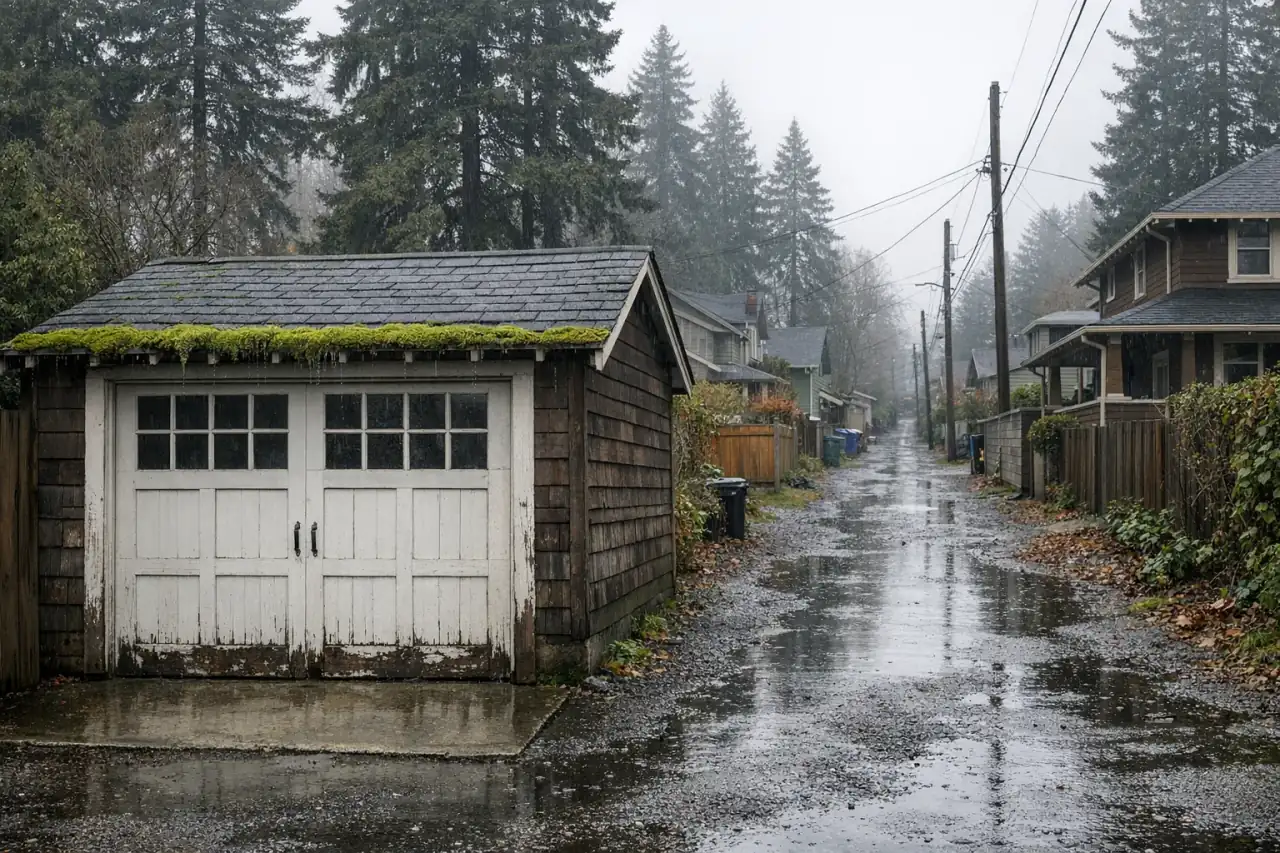
Rain here is less about downpours than persistence. Long-term averages put it at nearly 41 inches a year spread over roughly 155 days with measurable precipitation; November, December and January are the wettest months, while July is close to dry.
Winters are mild, with January lows averaging in the upper 30s, and in that cool, damp air water clings to hardware and soaks into wood instead of drying off. That dampness, aging North End garages and salt off Puget Sound explain a good share of the door trouble in Tacoma.
Rust that starts on the inside face
A cold steel door in an unheated garage behaves like a glass of ice water on a muggy day. Damp air condenses on the inner skin overnight and, through a mild, gray winter, simply lingers. Corrosion tends to show first along the inside bottom edge, at hinge knuckles and around the spring shaft's bearing plates.
Check those spots each autumn with a flashlight. Orange streaks below a hinge, grinding rollers or flaky scale on spring coils mean rust has a head start, and pitted spring wire can snap without warning.
Leave corroded springs and cables alone: both hold enough stored force to break bones when released, and the bottom brackets they anchor to carry the same load. A technician can replace them. Ask whether galvanized springs and sealed-bearing nylon rollers suit your garage, or whether an insulated door, which sweats less, is worth it.
Moss, mildew and jambs that quietly go soft
Wood decays from the bottom up here. Roof runoff with no gutter splashes the lowest foot of the jambs, moss along the eaves keeps that edge wet, and north-facing doors that never see winter sun grow mildew that traps moisture against the paint.
The jamb matters more than the door. Each vertical track is lagged into it, so once the wood softens the track drifts, rollers bind and the door can jump the track. If an awl sinks easily into the jamb near the floor, the decay is structural.
Ask the technician to inspect the jamb before re-anchoring anything. A lasting fix replaces the decayed wood, often with cellular PVC, and fastens the track into sound framing; longer screws in punky wood only postpone the problem.
- Clear moss and fir needles from the roof edge so water drains away from the header.
- Seal the end grain on a wood door's bottom rail, where water gets in first.
Fitting modern hardware into a North End alley garage
The North Slope Historic District holds more than 900 homes built between 1881 and 1955, and the city's design guidelines note that early garages and carriage houses there were built apart from the house and, where an alley exists, nearly always entered from it. Where one survives, expect it to be small by today's standards and possibly out of square after decades of settling.
Fitting one with a sectional door and opener is often possible, but measure first: opening width and height, headroom, side clearance for tracks and depth to the rear wall. Headroom may be short, and a sagging header may need reinforcement before it can carry spring hardware.
If there is no ceiling outlet, an electrician may need to add one first. With no side door, ask about an exterior keyed release so you can get in during an outage.
Ask the Historic Preservation Office before swapping a door
North Slope and the Wedge follow design guidelines adopted by the Landmarks Preservation Commission. Work needs commission review when it involves a contributing structure, changes the exterior and requires a building permit. Painting and minor repairs such as weather-stripping that need no permit are exempt.
Detached garages get extra scrutiny. In North Slope, the exemption for non-contributing properties excludes accessory structures, and in the Wedge Historic District, alterations to accessory structures are not exempt either. Expect the guidelines to favor repair, then an in-kind match. For new garages, they call attached garages and carports inappropriate and want vehicle doors facing the alley when possible.
- Does my replacement door need a building permit?
- Are the house and the garage listed as contributing in the district inventory?
- Which photos, specifications and drawings belong with the application? The guidelines list commission meetings on the second and fourth Wednesdays, so check the current calendar.
Salt mist on the Gig Harbor and University Place waterfront
Across the Narrows in Gig Harbor and along the University Place shoreline, salt-laden air off the Sound adds to the rain. Salt holds a wet film on metal, so springs, cables, bottom brackets, opener chains and sensor brackets corrode faster than a few miles inland.
Rinse the lower hardware with fresh water every few weeks in the wet season and touch up paint chips on steel before rust creeps under them. When parts wear out, ask about powder-coated springs, stainless fasteners and a belt-drive opener; for a new door, aluminum or fiberglass skins will not rust the way steel does.
Gig Harbor ZIP codes also reach unincorporated Pierce County, so confirm which office has jurisdiction before ordering a door that needs a permit.
From the Narrows to the Puyallup Valley
Requests reach us from both sides of the water and from up the valley.
- Tacoma: 98409, 98444 and 98466, a ZIP shared with part of University Place
- University Place: 98467, with its own Puget Sound shoreline
- Gig Harbor: 98332, on the Gig Harbor Peninsula
- Puyallup: 98371, in the Puyallup Valley to the southeast
- Spanaway: 98387, unincorporated Pierce County
- Ravensdale: 98051, a former coal town in southern King County
- Seattle: 98199, covered on the Seattle page
Last updated by the American Garage Door Team.