
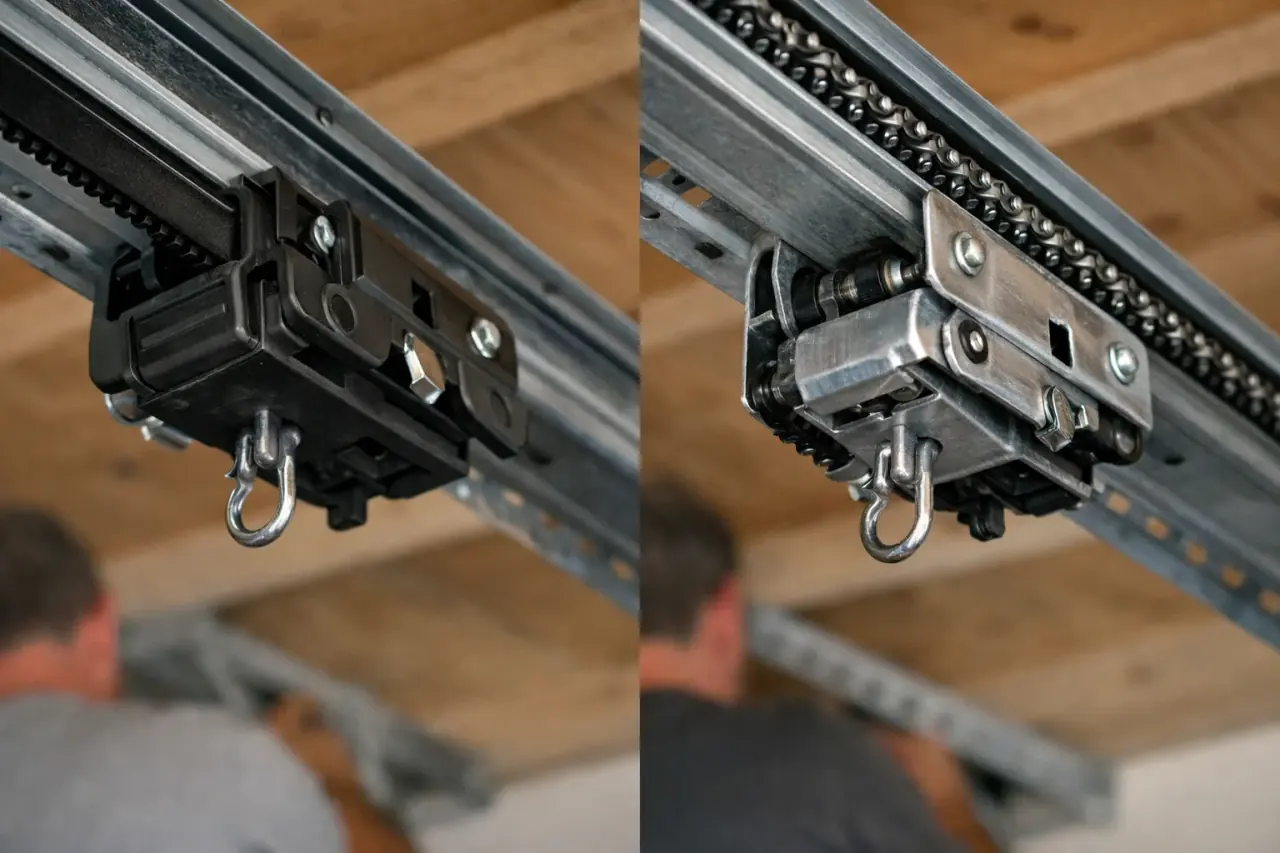
How do the four opener drive types work?
Every residential opener does the same basic job: a motor turns, something transfers that motion to the door, and the springs do the heavy lifting. The "drive" is the something in the middle, and it decides most of what you'll notice day to day: noise, vibration, maintenance and where the opener sits.
Chain drive
A metal chain runs along a rail from the motor unit to the header above the door. The motor turns a sprocket that pulls the chain, which drags a trolley connected to the door arm. It's the oldest and most common design.
Chains are strong, tolerate heavy doors and rough treatment, and are inexpensive to replace. The trade-off is sound: the metal chain on a metal rail clanks and transmits vibration into the ceiling framing.
Belt drive
Same layout, but a steel-reinforced rubber or polyurethane belt replaces the chain. Belts run far more quietly and smoothly, especially when paired with a DC motor that ramps up and slows down gently. They cost more than chains and need no lubrication; in fact, grease on a belt attracts grit and can make it slip.
Screw drive
A long threaded steel rod sits inside the rail and rotates; the trolley rides along the threads. There are fewer moving parts and no chain or belt to tension. Screw drives can be quick and simple to maintain, but they can be noisier than belts, and grease on the rod is affected by temperature extremes. They need the specific lubricant the manufacturer recommends.
Wall-mount (jackshaft)
Instead of hanging from the ceiling, the motor mounts on the wall beside the door and connects directly to the end of the torsion shaft. When it turns the shaft, the cable drums wind the lift cables and the door rises. There's no rail, no trolley and no overhead unit.
That makes it the quietest common option and frees the ceiling for storage racks, a car lift, or a high-lift track. It requires a torsion-spring door with enough shaft extending past the side, and most models include a cable-tension sensor. If you're not sure which springs you have, see torsion vs. extension springs.
How do they compare side by side?
| Chain | Belt | Screw | Wall-mount | |
|---|---|---|---|---|
| Noise | Loudest | Quiet | Moderate | Quietest |
| Typical U.S. unit price | $150–$300 | $200–$450 | $180–$350 | $400–$900 |
| Routine upkeep | Occasional tension check | Minimal | Rod lubrication | Minimal |
| Ceiling space used | Full rail | Full rail | Full rail | None |
| Door requirements | Most sectional doors | Most sectional doors | Most sectional doors | Torsion springs only |
| Good fit | Detached garages, budgets | Garages under bedrooms | Simple, steady climates | High ceilings, lifts, storage |
Prices are typical U.S. retail ranges for the unit only and vary by brand, motor type, features and region. Professional installation adds labor; installed totals are broken out in DIY vs. pro opener installation.
Is a belt drive worth the extra money over a chain?
Ask one question: what's above and beside the garage?
- A bedroom, nursery or home office over the garage: belt drive or wall-mount. The difference at 6 a.m. is real.
- An attached garage sharing a wall with the kitchen or living room: belt drive is usually worth the modest premium.
- A detached garage or shop: chain drive. Noise doesn't reach anyone, and chains are hard to beat on value.
- A heavy wood or oversized door: chain or a robust belt model with ample motor capacity; check the manufacturer's door size and weight ratings.
Remember that much of a "loud opener" complaint is really door noise: dry hinges, worn rollers and loose track hardware. Swapping to nylon rollers and servicing the hardware can quiet a door more than changing drives. Quieting the door itself is often the cheaper fix.
Does motor type matter as much as drive type?
Often more. Openers use either an AC or a DC motor:
- AC motors are the traditional design: simple and durable, but they start and stop abruptly and run at one speed.
- DC motors start softly, slow down before the door hits the floor or the top, run quietly, and accept backup batteries. Manufacturers often label them with an equivalent rating, such as "HPc" or "HPS," rather than true horsepower, so compare those figures within a brand rather than across brands.
A belt drive with a DC motor is the quietest ceiling-mounted combination. DC motors also make it easy to meet California's backup-battery law.
On horsepower: most balanced residential doors don't need more than 1/2 HP. Heavier doors justify 3/4 HP or more. But extra horsepower is never a fix for weak springs. An opener only guides a balanced door.
How does climate affect the choice?
- Cold garages: Screw-drive grease stiffens in the cold, and any opener struggles more if lubricant thickens or the bottom seal freezes. Belt and chain drives tend to be less fussy.
- Hot, unconditioned garages: Plastic and rubber parts age faster in extreme heat. Choose quality belts and keep the opener out of direct sun through windows when possible.
- Coastal and humid areas: Salt air and humidity rust exposed chains and hardware, as any garage in Florida shows. Belt drives avoid chain corrosion; wall-mount units remove the overhead rail entirely.
What maintenance does each drive need?
- Chain: Check for sag every six months; a chain that droops well below the rail needs adjusting per the manual. Many chains need little or no added lubricant; follow the manufacturer's guidance.
- Belt: Look for cracks or fraying once a year. Never lubricate the belt.
- Screw: Clean and re-lubricate the rod as the manufacturer specifies, using their recommended grease.
- Wall-mount: Have a technician check the torsion shaft, drums and cables during routine service; don't adjust them yourself.
- All types: Test the auto-reverse with a 2x4 laid flat and wave something through the photo-eye beam monthly.
For rollers, hinges and the rest of the door's hardware, see which lubricants to use where.
Should you install the new drive yourself?
Swapping a chain unit for a belt unit on a balanced door is a fair weekend project. Wall-mount installs, doors that need spring adjustment, low headroom, and heavy or oversized doors that need careful sizing are better left to a technician.
We install chain, belt and wall-mount openers, including straight swaps from one drive type to another, and we also handle replacement doors. Still deciding on a brand? Here's how Chamberlain, LiftMaster and Genie differ. Free estimates are available for any of it.
Key takeaways
- Chain: cheapest and toughest, but loudest.
- Belt: quiet and smooth; the default for garages near living space.
- Screw: few parts, but picky about lubricant and temperature swings.
- Wall-mount: quietest and frees the ceiling; torsion-spring doors only.
- A DC motor and a balanced door matter as much as the drive.