
What is that noise? A sound-by-sound guide
Garage doors don't get loud for no reason. Each kind of noise points to a different part, so start by listening closely while someone runs the door, and note where the sound comes from: the door, the tracks, the springs or the opener on the ceiling.
| Sound | Likely source | Usually means |
|---|---|---|
| Squeak or squeal as the door moves | Hinges, roller bearings, spring coils | Dry pivot points; lubricate |
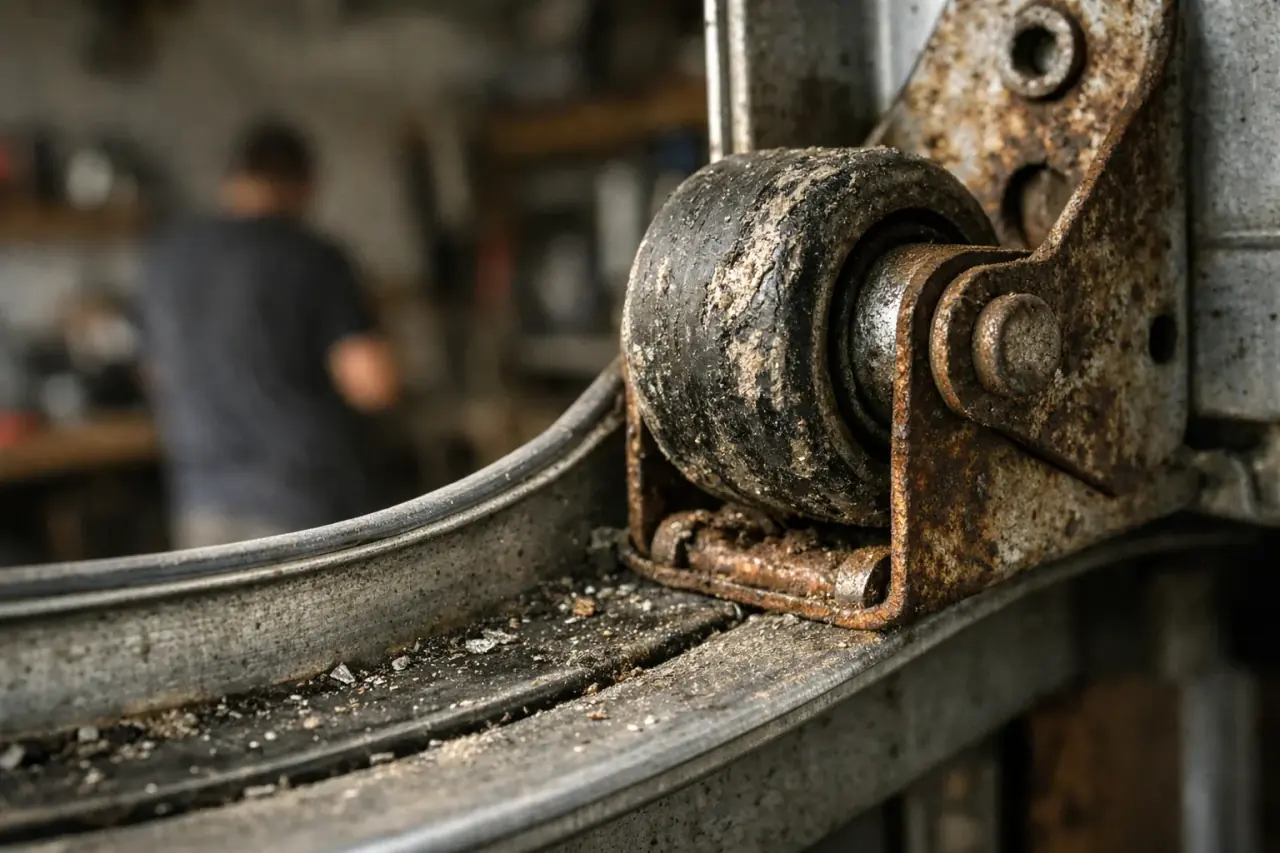
| Grinding or scraping | Rollers or tracks | Worn bearings, flat-spotted rollers or a bent or misaligned track |
| Rattling or buzzing | Hardware, panels, opener mount | Loose bolts, thin panels vibrating, opener hanging loose |
| Popping or creaking from above the door | Torsion spring | Coils binding from lack of lubrication, or a spring wearing out |
| Slapping or clanking from the ceiling | Opener chain | Chain too slack and hitting the rail |
| Thud at the end of travel | Opener limits or door balance | Close limit set too far, or a door heavy enough to drop the last few inches |
| Humming with little or no movement | Opener motor | Motor straining against a door that won't move; often a broken spring |
| One loud bang, then the door won't lift | Spring | A broken spring; stop using the door |
The last two rows are not noise problems. They're repair calls. Everything else on the list can often be improved with an hour of basic maintenance.
How do you quiet a noisy garage door step by step?
Set aside about an hour. You'll need a socket set, a stepladder, rags and a can of garage-door lubricant, either silicone or white lithium spray.
- Lower the door fully, then pull the opener's plug. A closed door won't shift while you work on hinges and rollers, and with the power off nobody can start it by remote while your fingers are in the hardware.
- Tighten the hardware. Snug every hinge bolt, the track bracket bolts into the wall and the bolts that hang the opener from the ceiling. Firm is enough; overtightening strips the thin steel. Leave the bottom corner brackets alone, along with anything attached to the springs or cables, and anything painted red.
- Lubricate the moving parts. Spray a light coat on each hinge pivot, the bearings inside the rollers, the torsion spring coils, the bearing plates at each end of the spring shaft, and the lock mechanism. On nylon rollers, aim for the bearing, not the nylon tread. Wipe off drips so they don't collect dust.
- Clean the tracks, don't grease them. Rollers should roll, not slide. A damp cloth with a little dish soap lifts grit and gummy residue from the channels; dry them before moving on.
- Check the rollers. Look for wobbling wheels, cracks, flat spots and exposed bearings with missing balls. Worn rollers are the most common source of grinding, and choosing between nylon and steel matters when you replace them.
- Check the opener drive. On chain-drive openers, a little sag at the middle of the rail is normal, but a chain that slaps the rail needs tightening to the spec in the manual. Belt drives generally don't need lubricant. Screw drives use the grease the manufacturer specifies.
- Restore power and listen. Run the door a few times. Then lay a 2x4 flat under the door and close it to confirm the opener still reverses on contact, since tightened hardware and fresh lubricant can change how the door travels.
Product choices and a full list of lube points are in the lubrication how-to.
How much of the noise comes from the opener?
Often more than people think, especially in homes with a bedroom or living space above or beside the garage. Openers make noise two ways.
The drive itself. Chain drives are the loudest, with metal running over metal sprockets. Screw drives fall in the middle. Belt drives are much quieter, and wall-mounted jackshaft openers move the motor off the ceiling entirely. Weigh the trade-offs in our drive-type comparison.
Vibration through the framing. An opener bolted straight to the ceiling joists turns the whole ceiling into a speaker. Rubber vibration isolators between the hanging brackets and the framing cut that transfer noticeably. Many newer openers also use DC motors with soft start and stop, which removes the jolt at each end of travel.
If your opener is old, loud and already giving trouble, replacing it may make more sense than tuning it again.
Does the door itself make a difference?
Yes. A single-layer, uninsulated steel door is essentially a large sheet of thin metal, and it booms and rattles as it moves. Doors with a polystyrene insert are better, and doors with polyurethane foam bonded between two steel skins are stiffer still and much quieter. If you're shopping, see how foam-core doors compare with hollow ones.
Worn hinges add their own clatter. When the holes in a hinge wear oval, the sections shift slightly with every movement. Hinges are inexpensive, and a handy owner can change them singly while the door is down; the bottom corner brackets that hold the cables are the exception and stay with a technician.
Why is my garage door louder in winter?
Cold thickens lubricants and stiffens weather seals and nylon parts, so doors that run quietly in summer can groan and pop in January. A fresh coat of a lubricant rated for low temperatures usually helps. If cold-weather noise comes with slow or jerky movement, the springs and opener deserve a look; see freezing-weather door fixes.
Which noises mean you should stop using the door?
Some sounds are warnings, not annoyances. Stop running the door and call a technician if you hear:
- A single loud bang, especially followed by a door that won't lift; that's typically a broken spring
- Grinding together with jerky or crooked movement, which can mean a roller is coming out of the track
- Scraping along one side, often a bent track or a door that has shifted in its opening
- Snapping or twanging near the bottom corners, a sign of cable strands breaking
- Loud creaking from a spring that doesn't stop after lubrication, which can mean the spring is wearing out
- The opener straining or humming while the door moves slowly or not at all
These all involve parts under tension or a door that's no longer properly guided. Read more on broken springs, fraying lift cables and derailed doors.
How much does it cost to quiet a garage door?
Ballpark national figures, which shift with region and door size:
- Lubricant and an hour of your time: the cost of a can of spray
- A full set of sealed nylon rollers as parts: often somewhere around $40 to $120 for a typical double door
- Professional tune-up with lubrication, tightening and adjustment: commonly around $75 to $200 before any parts
- Professional roller replacement: usually added to a tune-up or repair visit; heavy doors and long-stem rollers cost more
- Quieter opener or insulated door: a larger project; compare repair-by-repair pricing
When is a noisy door worth a service call?
When it's still loud after tightening and lubricating, when the racket comes from the springs, cables or bottom brackets, or when the door travels unevenly. A professional tune-up covers balance, springs, cables, rollers, hinges and opener settings in one visit. New rollers and hinges fall under hardware replacement, and loud or straining motors go to opener service. Schedule a visit whenever it suits you.
Key takeaways
- Identify the noise first: squeaks, grinding, rattles, pops and bangs all point to different parts.
- Tighten hardware, lubricate pivots and bearings, and clean the tracks without greasing them.
- Sealed nylon rollers, a belt or wall-mount opener and vibration isolators make the biggest difference.
- Insulated doors are stiffer and quieter than single-layer steel.
- A bang, a grind with crooked movement or a straining opener means stop and call a technician.