
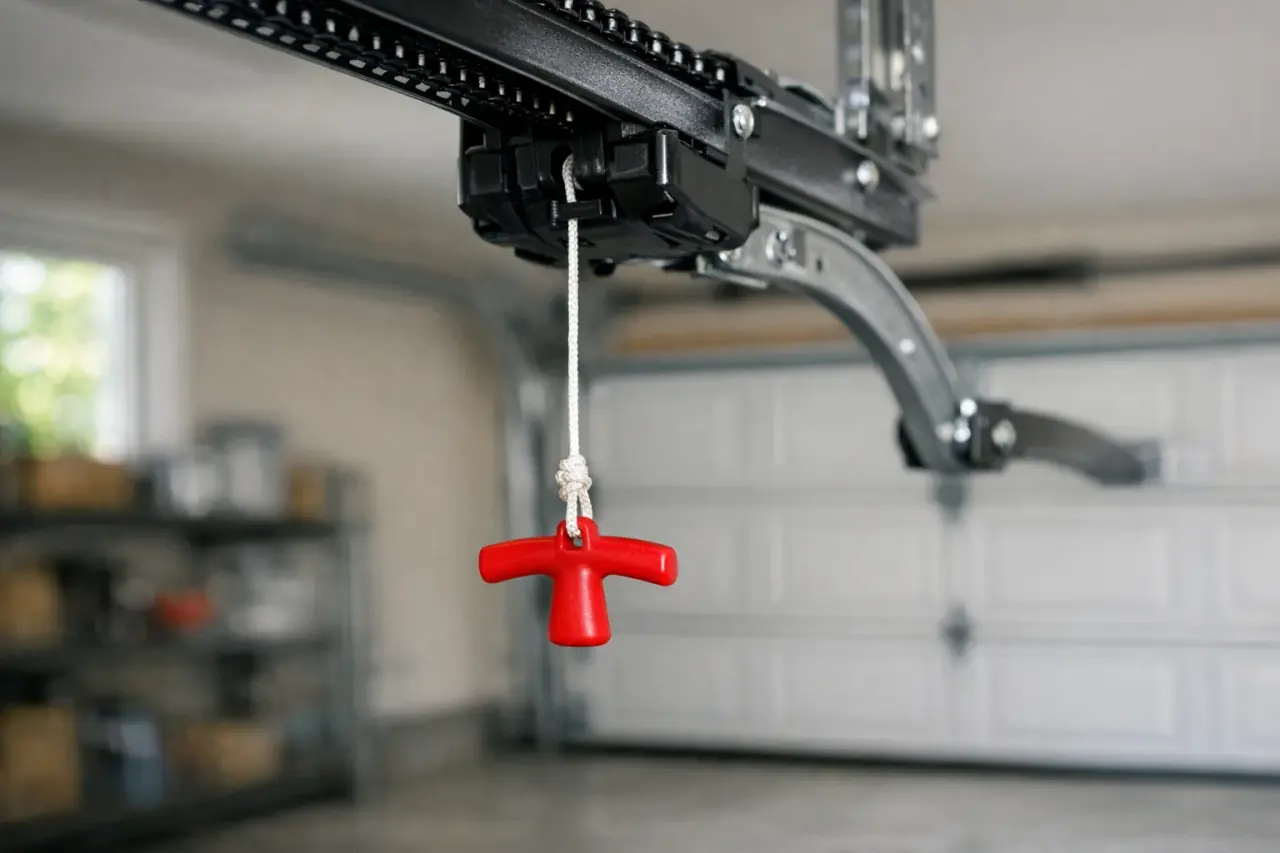
What is the red handle hanging from your garage door opener?
That red handle is the emergency release, sometimes called the manual release. It hangs on a short cord from the trolley, the part that rides along the opener's rail and connects to the arm bolted near the top of your door. Genie calls the same part the carriage.
Inside the trolley is a latch. When it's engaged, the opener's chain, belt or screw drags the trolley and the door moves with it. Pulling the cord frees that latch. The drive stays where it is, while the door, its arm and the trolley slide along the rail by hand.
A few things about it are worth knowing before you ever need it:
- It only disconnects the opener. It does nothing to the springs, which still carry the door's weight.
- It's not a door handle. Use the cord only to trip the latch. To move the door, lift from the inside handle or the bottom section, where your hands can control it.
- Wall-mounted openers differ. Openers that sit beside the door on the end of the spring shaft, rather than on a ceiling rail, release the door in their own way. Follow that model's manual.
When should you use the emergency release?
The release exists for the moments when the opener can't move the door but you still need to. The common ones:
- A power outage on an opener with no backup battery, or one whose battery has run down.
- A dead or broken opener, such as a burned-out motor, a failed circuit board or a stripped drive gear.
- An urgent need to get out, when the car or a person has to leave the garage and the motor won't respond.
- A balance check, where you disconnect the door to feel whether the springs are still lifting their share of the weight.
If your power goes out often, an opener with built-in battery power saves you from doing this every storm. We explain how that works in our battery backup guide.
When is it dangerous to pull the emergency release?
Safety warning: Don't pull the release while the door is open or partly open if a spring or cable might be broken, if the door is hanging crooked, or if it has come out of its tracks. With the springs no longer doing their job, the opener may be the only thing holding that door in the air. Release it and the full weight drops.
Opener makers say so in their own manuals. Genie, for one, tells owners to use the release only with the door closed when possible, and warns that weak or broken springs can make an open door come down faster. That's a heavy door dropping quicker than anyone can step aside or catch it.
Before you touch the cord on an open door, look up and across from a safe spot:
- Torsion spring: a visible gap in the coil on the bar above the door means it has snapped.
- Extension springs: a spring above either horizontal track that's in pieces, missing or dangling from its safety cable.
- Cables: a cable that's slack, frayed or off its drum or pulley.
- The door itself: one side lower than the other, or rollers out of the track.
If you see any of these, leave the cord alone, keep people and cars out of the opening, and call for repair. Our guide to garage door emergencies covers how to secure the house while you wait.
How do you disconnect the door with the emergency release?
This is the safe routine for a closed door with springs and cables that look intact.
- Start with the door fully down if it's at all possible.
- Unplug the opener at the ceiling outlet, or switch off its circuit if it's hardwired, so it can't start up if the power returns while you're working.
- Clear the opening of people, pets, bikes and anything stored against the door.
- Pull the handle down firmly. Some models want the pull angled toward the opener, Genie's carriage lock among them. The tag by the handle or your manual shows which.
- Lift from the bottom. Use the inside handle or grip the bottom edge with both hands, palms flat, keeping fingers away from the hinged seams between sections.
- Raise it all the way. A door in good balance goes up with moderate effort and stays open. If it feels very heavy or won't stay put, lower it under control and leave it closed.
- Reconnect before you walk away. Once the opener is disconnected, nothing holds the door shut. Reconnect it as soon as you can, or before you leave the house.
What if the door is stuck open when the power fails?
Look at the springs and cables first, using the list above. If anything looks wrong, don't release it. If everything looks normal, keep everyone out of the doorway, since that's where a falling door lands, and pull the cord from inside the garage. If the door holds still, lower it slowly with the inside handle. If it starts to drift or drop on its own, let go and step away rather than trying to catch it.
How do you reconnect the garage door to the opener?
Once power is back or the opener is fixed, reconnect the trolley before you rely on the remote again.
- Close the door by hand and make sure nothing is under it.
- Reset the release. Designs vary. On some, the latch is ready to catch again as soon as you let go of the cord. On Genie models you either push the release lever back up into its locked position or pull the handle toward the door, depending on the opener.
- Plug the opener back in if you unplugged it.
- Press the remote or wall button. The drive moves its connector along the rail until it reaches the trolley and latches. Some manuals have you move the door by hand until it catches instead.
- Run one full cycle up and down and watch it the whole way.
- Check the safety reversal. Wave something through the photo-eye beam while the door is closing; it should stop and reverse.
If the drive runs past without catching, the release is probably still set to its unlocked position. If the motor runs but nothing moves along the rail, the chain, belt or drive gear may be the problem; this guide to doors that won't open walks through those sounds. And if you pulled the release because the door felt heavy or ran crooked, don't reconnect it. That's a spring or cable problem, and the opener will only strain against it.
Why won't the emergency release let go?
A release that refuses to disconnect is almost always telling you something. Work through the likely causes before you pull harder.
| What you notice | Possible cause | What to do |
|---|---|---|
| Cord pulls tight but nothing happens | Load on the latch from a jammed or binding door | Stop pulling; unplug the opener and look for the jam |
| Handle comes down with no resistance | Cord snapped or knot slipped out of the lever | Replace the cord with the door closed |
| Lever moves only partway | Lever bent, rusted or gummed with old grease | Have the trolley inspected or replaced |
| Door relatches as soon as you move it by hand | Some designs relatch unless the release is set to unlocked | Check the manual for how your model holds the release open |
| Door disconnects when nobody touched it | Handle hanging low enough to snag a roof rack or tall vehicle | Shorten the cord to the manual's height |
Never hang your body weight on the cord, climb on something to yank the trolley, or pry at the latch with a screwdriver. If load is pinning the latch, freeing it suddenly can let the door lurch. A stubborn release on a door that's also crooked or heavy is a job for a technician.
How do you release the door from outside the garage?
If the garage door is the only way into the garage, a power outage can lock you out along with the car. The fix is an outside emergency release, often sold as a key release kit by opener manufacturers.
On a sectional door, the kit's small keyed lock usually goes through the top section, with a cable running from the back of the lock to the release on the trolley. With Genie's kit, for example, you turn the key, pull out the lock cylinder and its cable, and that trips the release just as the red handle would. Genie's opener manual suggests considering a kit if the garage has no separate entry door.
A few points to weigh before you add one:
- Placement matters. The lock goes directly below the trolley's release, so check what sits at that spot, such as a window, before anyone drills.
- It's a new entry point. Use the opener maker's kit, treat the key like a house key, and read our garage security checklist for ways to keep the release from being fished through the top gap.
- Once released, the door is unlocked. It stays that way until you reconnect the opener.
A backup battery is the other answer, since the remote keeps working through the outage. Having both covers you if the battery has run flat.
How high should the release handle hang?
Check the manual for your opener before you cut or retie anything. Genie's replacement-cord instructions put the handle at about 6 feet above the floor, or high enough to clear a vehicle. One of its opener manuals says to mount the release within reach but at least 6 feet up, away from vehicles, so it doesn't get pulled by accident.
The goal is a handle an adult can reach without a ladder but that a car roof, roof rack or the back of a tall van won't catch on its way in. A handle that's too low can be snagged by a vehicle, which disconnects the door without anyone noticing. One that's too high is useless in the dark during an outage.
How do you replace a worn emergency release cord?
A frayed, stiff or knotted cord is worth replacing before it snaps at the wrong moment. This is safe homeowner work because it never goes near the springs.
- Close the door, unplug the opener and get the cord-and-handle kit made for your opener brand.
- Untie the old cord from the release lever and the handle.
- Feed the new cord through the lever and secure it as the kit instructions show, then set the handle at the height in your manual and knot it.
- Work the lever by hand to make sure it moves freely and springs fully back.
- Trim the excess, reset the release, plug the opener in and run the door once to confirm it reconnects.
When should you call a professional?
Call a technician instead of experimenting when:
- A spring is broken or a cable is loose and the door is stuck open
- The door is crooked, off its tracks or won't stay up by hand
- The release won't disconnect, or the trolley disconnects on its own
- The trolley won't relatch after a few tries
- You want an outside key release installed and aren't sure where it should go
Springs and cables hold enormous stored tension, and adjusting or replacing them takes the right tools and training. We can send a technician for spring and cable repairs, trolley and opener fixes and urgent after-hours calls. American Garage Door is available 24/7 with same-day service in most areas, and you can ask for a free estimate.
Key takeaways
- The red handle disconnects the door from the opener; it never touches the springs.
- Use it with the door closed whenever possible.
- Never release an open door with a broken spring, a loose cable or a crooked panel.
- A disconnected door isn't held shut, so reconnect the opener before you leave.
- A garage with no side entrance should have an outside key release, a backup battery, or both.
- A release that won't let go, or lets go by itself, needs a technician's look.