
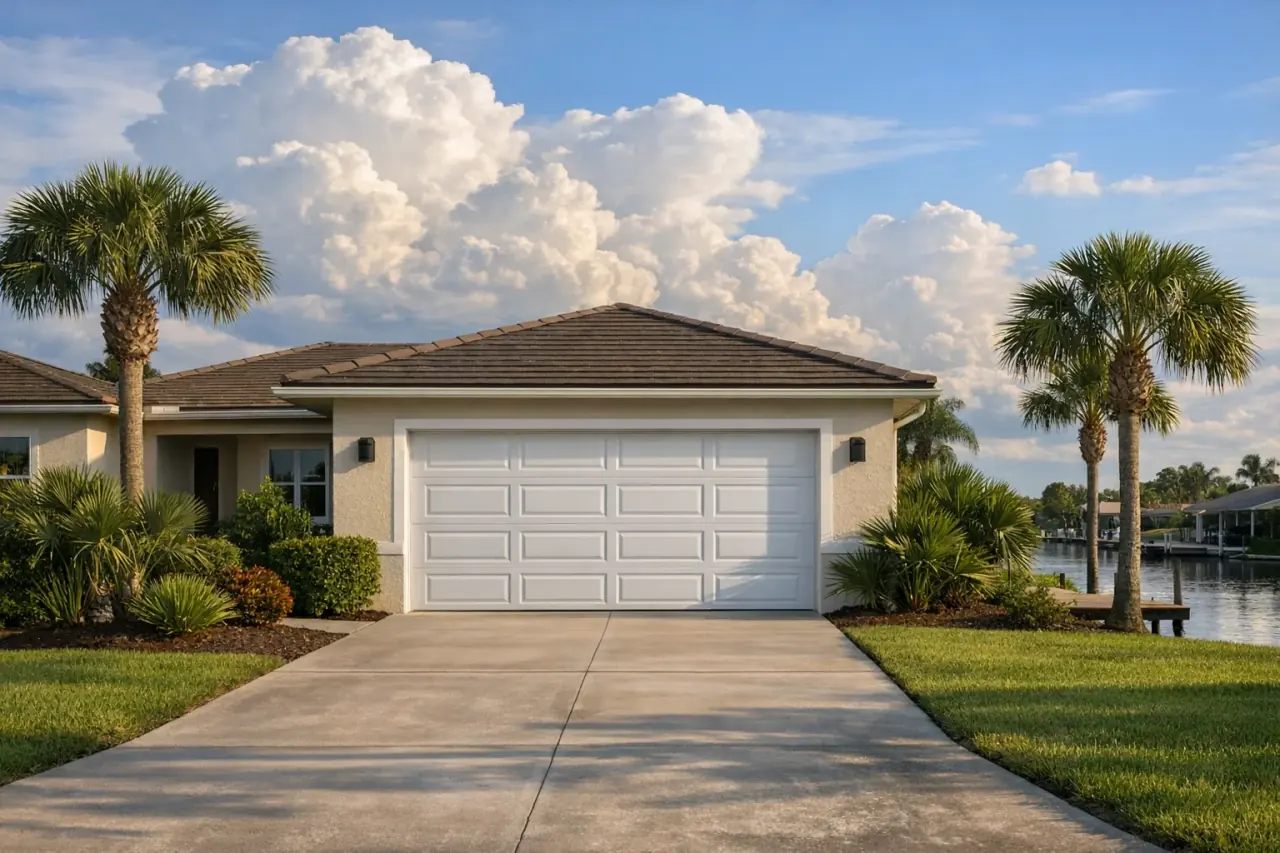
Port Charlotte started in the 1950s as one of the General Development Corporation projects run by the Mackle brothers, platted at the north end of the Charlotte Harbor estuary. North Port began as the northern piece of that same development. Port Charlotte itself never incorporated, so the Board of County Commissioners governs it and county staff, not a city hall, issue the building permits.
Two Category 4 hurricanes have hit the community eighteen years apart. Charley tore through on August 13, 2004, and in September 2022 the southeastern side of town sat in the eye of Ian, where a private weather station logged a 132 mph gust. That history, an older population and county permit rules shape most garage door decisions here.
What the Charlotte County door permit actually asks for
The county writes its residential door permit for one specific job: installing an exterior door or a garage door in an existing opening, at the same size, without altering that opening. Swapping an old door fits that description, so ask who files the paperwork and who meets the inspector.
The application wants the door's complete approval number from the Florida or Miami-Dade database, including the digits after the decimal point, plus a floor plan marking where the door goes. Plan review checks the structure against the Florida Building Code, wind loads and flood loads included. On larger contracts the county also wants a recorded Notice of Commencement before the first inspection can be booked.
Homes in a flood zone face one more test. The county adds the cost of the new work to past repairs, and if the running total tops 50 percent of the building's market value, the whole house must be brought up to current floodplain standards. Ask how the door counts toward that total before you sign.
Wider opening, bigger project
Trading two single doors for one double, or raising an opening for a taller vehicle, changes the opening and falls outside the simple door permit. The header over the door carries roof load, so reworking it is structural; ask the county, or Punta Gorda if your lot is inside city limits, which permit path applies before ordering anything.
A wider door also catches more wind. A 16-foot door presents far more surface to a storm than a 9-foot single, so rated models that wide generally carry heavier reinforcement, such as extra horizontal struts and stronger track anchoring. Make sure the quote names the exact model and its design pressure.
Side-mounted springs on older doors
Some older and lighter doors still run on extension springs, the long coils stretched alongside the horizontal tracks, instead of one torsion spring on a bar above the opening. Each of those springs should have a steel safety cable threaded through its center. If a spring snaps without one, the broken coil and its hardware can whip across the garage.
You can check for that cable from the floor without touching anything: look along each side spring for a thin wire rope running through it, tied off at both ends. If it is missing, ask a technician to add one. Adjusting, unhooking or replacing these springs is never a homeowner job, because they are stretched under heavy tension whenever the door is down.
When the power is out and the door is too heavy to lift
Port Charlotte skews older; at the 2020 census, about three in ten residents were 65 or over. When a storm knocks out power, raising the door by hand is often the only way to get a car out.
A properly balanced door, released from the opener while it is all the way down, should lift with modest effort and stay put partway up. If it takes real strain or slides back down when you let go, the springs are weak or out of adjustment, and that calls for service, not more muscle.
Ask about an opener with a built-in battery backup, or whether your current unit accepts one. An outside keypad saves crossing a dark house to reach the wall button, and if you live alone, ask a neighbor to look in on the garage after a storm.
Doors that rode out Charley and Ian
Charley damaged or destroyed a large share of the county's homes, and Ian brought another wave of replacements, so the doors on one block can span several generations of building code. Some predate the first statewide Florida Building Code, which took effect on March 1, 2002.
A door that still opens is not necessarily sound. Look for a horizontal strut that has kinked or pulled loose, a section whose end stile has cracked around the hinge screws, and track brackets that have shifted on the wall. Those parts carried the wind load, and once they bend, the door won't resist the next storm the way it was designed to.
From the GDC grid to Rotonda's wagon wheel
North Port was incorporated as North Port Charlotte in 1959, and many of its older streets trace back to the same developer. Rotonda West, laid out like a wagon wheel, is a deed-restricted planned community that Cavanagh Communities began after buying the land in 1969. Venice is in Sarasota County, while Englewood straddles the county line, so the permit office there depends on which side your lot is on.
Each community on this list has had garage door work done. Not on it? Ask anyway; the list reflects past jobs, not a boundary.
- Port Charlotte (33948, 33952, 33953, 33954, 33980, 33981)
- Punta Gorda (33950, 33955)
- North Port (34286, 34287, 34288)
- Venice (34292, 34293)
- Englewood (34223, 34224)
- Rotonda West (33947)
- Placida (33946)
Last updated by the American Garage Door Team.