
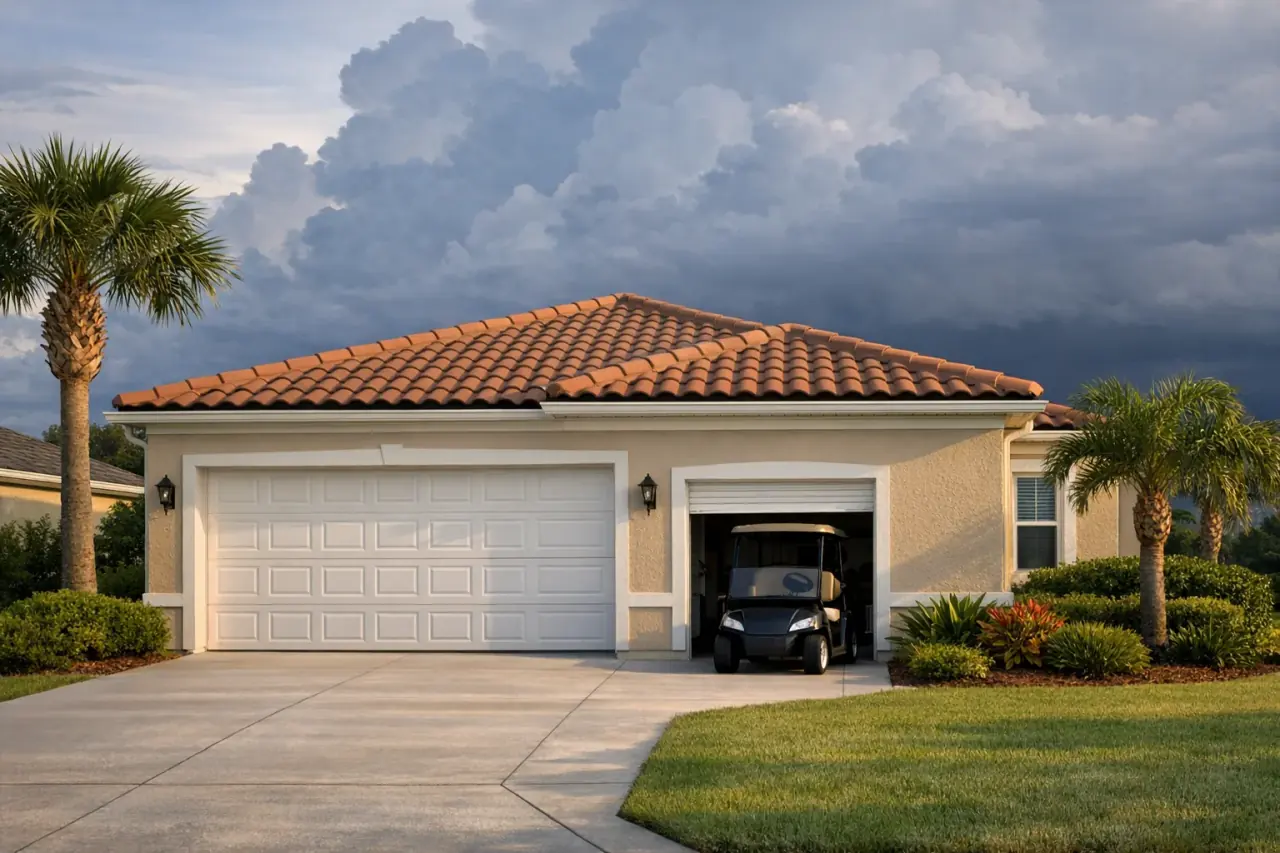
The Villages is an age-restricted, 55-plus community spread across Sumter, Lake and Marion counties, and so much of life here moves by golf cart that carts have their own bridges over State Road 44 and Florida's Turnpike. Many homes pair a two-car garage with a separate golf car garage, which puts a second, narrower door beside the main one.
Three more things shape the work: deed restrictions enforced through district architectural review, residents who should not be hoisting a heavy door by hand, and Central Florida's summer lightning.
The narrow door beside the big one
Resale listings around town often describe a two-car garage plus a golf car garage, and that cart bay has its own door, which may or may not have its own opener. Daily trips to the pool or a town center rack up cycles fast. Rollers flatten, the bottom seal tears where a bumper rubs it, and the lowest panel dents when a cart creeps forward too soon.
Each lower corner of that panel holds a bracket with the lift cable under heavy tension. If a cart catches the corner and the bracket bends or a cable frays, leave the door where it is and have a technician replace the hardware. A small door still runs on springs strong enough to hurt someone.
- Program a spare remote for the cart door and clip it inside the golf cart.
- Run charger cords along the wall, not across the opening, where the door can pinch them or they can droop into the sensor beam.
Architectural review: what needs an application and what doesn't
In The Villages, exterior questions go not to a typical homeowners association but to the Architectural Review Committee, supported by the District Government's Community Standards department. The ARC applies the manual approved by your district's Board of Supervisors, read alongside the Declaration of Restrictions for your unit, and every manual starts from one rule: exterior modifications need approval unless the manual says otherwise.
Garage door rules differ from one manual to the next. Under the Lady Lake and Lake County manual, a home needs no application for glass inserts, decorative panels, a garage door screen or repainting within the hue range of the base and trim colors, but changing the door's height or width does. Courtyard villas get the same add-ons without review, yet the door can be repainted without review only in its original color and must keep its original size, and on corner and end-lot courtyard villas that add a golf cart garage, the cart door can be no wider than eight feet.
The manual for Districts 13 through 15 is looser on paint, asking only that the color suit the neighborhood, and it extends the same exemptions to every housing type, though any change in height or width still goes to review. A replacement in a new panel style is not on either exempt list, so call Community Standards before ordering one. A new door also needs a wind-load approval, even this far from the coast; our wind-rating explainer covers inland addresses.
Every application needs your site plan, usually found in your closing papers. The Lady Lake and Lake County manual keeps an approval valid for nine months, so book the installation inside that window. The building permit is a separate step from the ARC; a short piece on permits explains it.
When nobody in the house should be lifting the door
Springs carry the weight of a balanced door, yet a recent shoulder repair, a bad back or shaky balance can make even that lift unwise. Here the opener is how the car or cart gets out during an outage, so ask for one with a built-in backup battery. Test it a few times a year by unplugging the unit, since garage heat wears batteries down faster.
Know the warning signs of a failed spring: a sharp bang from the garage, a gap in the coiled spring above the opening, or an opener that lifts the door a few inches and quits. Do not pull the red emergency release with the door up, because without spring support it can drop hard. Keep people and carts clear and call for a technician.
Openers made for sale in the U.S. since January 1, 1993 must meet a federal entrapment protection standard, which is why current units reverse on contact and most carry photo eyes mounted low on the tracks. A unit with neither eyes nor a reversing edge strip is overdue for replacement. If yours has eyes, pass a broom through the beam monthly as the door closes and confirm it reverses.
Afternoon lightning and the opener's circuit board
Florida ranked first among the states for lightning density in Vaisala's 2022 lightning report, and Four Corners, the U.S. community with the most lightning that year, sits partly in Lake County. On summer days, breezes off the Gulf and the Atlantic push moist air inland, and where they collide, storms can turn stronger.
A strike does not need to hit the house to ruin an opener. Surges come in on the power line and on the thin wires to the wall button and safety eyes, and the logic board usually takes the hit. Typical signs are a dead unit after a storm, a remote that suddenly does nothing, or a door that won't close while a sensor light blinks.
First check the breaker and any GFCI outlet in the garage, since a tripped outlet mimics a fried opener. If power is fine, have the board and sensors tested separately, because one can fail while the other survives. Lightning rods need no ARC review, but they do not stop surges in the wiring, so ask an electrician about surge protection at the panel.
From Lady Lake west to Homosassa
Calls come from both sides of several county lines:
- Lake and Sumter counties: Lady Lake (32159, 32162), The Villages (32163), Leesburg (34748), Okahumpka (34762) and Lake Panasoffkee (33538)
- North in Marion County: Ocala (34481)
- West in Citrus County: Inverness (34450), Hernando (34442), Lecanto (34461), Beverly Hills (34465) and Homosassa (34446)
Last updated by the American Garage Door Team.